


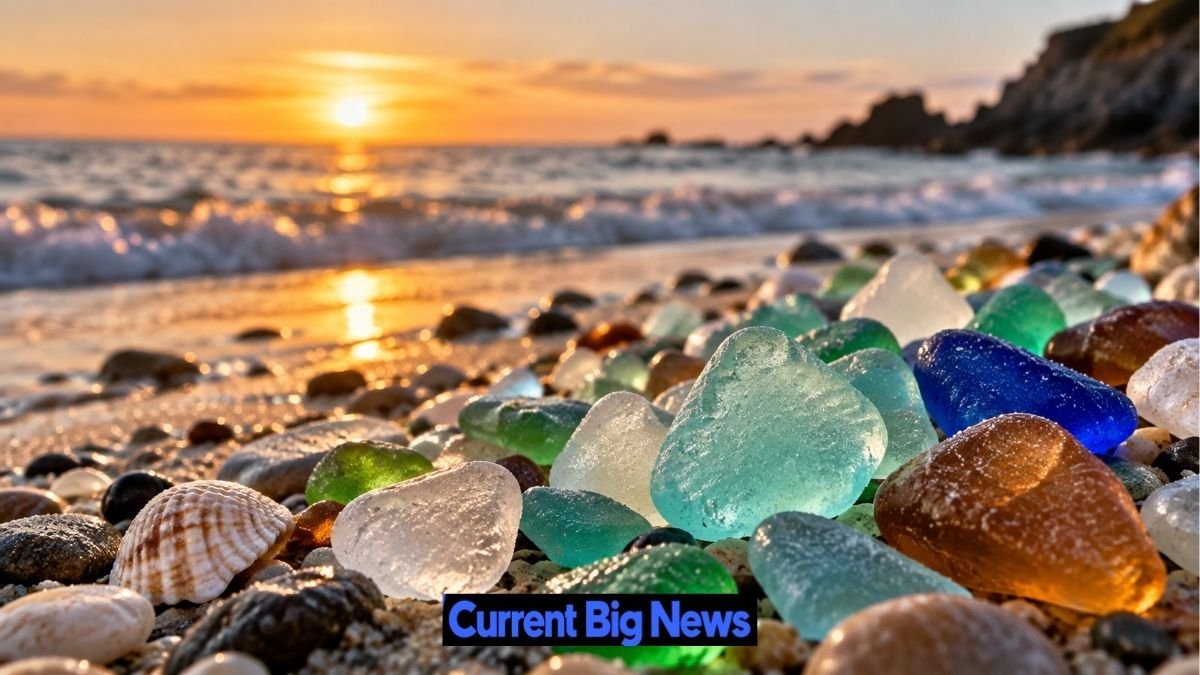
Sea glass looks simple at first: a smooth, frosted piece of colored glass resting among shells, stones, and sand. Yet every fragment carries evidence of a much longer process. Bottles, tableware, containers, and other discarded or lost glass can spend decades rolling through waves, scraping against sand, and weathering in saltwater before reaching the rounded appearance collectors value.
For beachcombers, sea glass appeals because no two finds share the same shape, shade, or history. Common greens and browns may reflect everyday bottle glass, while unusual colors can be harder to encounter. Understanding how these pieces form also helps distinguish naturally weathered material from newly manufactured decorative glass.
What Is Sea Glass?
Sea glass is ordinary manufactured glass that has been naturally altered through prolonged exposure to a marine environment. It commonly originates from bottles, jars, tableware, maritime waste, or household objects that entered the sea years or even generations ago.
Repeated movement through surf gradually breaks sharp fragments into smaller pieces. Sand, pebbles, rock, and other sediment abrade the surface while chemical weathering contributes to the characteristic cloudy or frosted finish. Eventually, dangerous edges can become smooth and rounded.
The transformation is slow. No universal number of years applies because conditions vary widely by location. Wave energy, beach geology, water chemistry, glass composition, and a fragment’s original thickness can all affect the weathering rate.
That uncertainty is part of the attraction. A genuine find does not arrive with a label explaining exactly where it came from or how long it spent in the water.
How Sea Glass Forms
Sea glass forms through both physical abrasion and long-term environmental exposure.
Imagine a broken bottle fragment entering the coastal zone. Each incoming and outgoing wave can move it across sand, gravel, stones, or rock. Repeated collisions gradually remove sharp corners. Surface scratches spread until the fragment develops the soft appearance commonly associated with naturally weathered glass.
Why Sea Glass Develops a Frosted Surface
The frosted appearance is one of the most recognizable features collectors look for.
Natural weathering creates numerous microscopic changes on the outer surface. Instead of reflecting light like a new bottle or freshly broken window, an older fragment often diffuses light, making it appear matte or cloudy.
A genuine piece can still vary substantially. Some fragments are heavily frosted, while others remain partly translucent. The amount of visible wear depends on the environment and exposure time.
Mechanical tumbling can imitate smooth edges, which is why smoothness alone doesn’t prove a piece spent decades in the ocean.
Why Different Colors Matter
Color is one of the easiest characteristics to notice when searching for sea glass.
Green, brown, clear, and pale blue pieces often reflect the widespread historical use of those glass colors in bottles and containers. Darker green and brown glass was often used to protect products from light, while clear glass has served countless household and commercial purposes.
Less commonly encountered shades can attract more attention from collectors because fewer mass-produced objects historically used those colors.
However, rarity is highly regional. A color that seems unusual on one coastline may appear more frequently near a location where a particular type of bottle, factory, port, or settlement once existed.
Common and Unusual Sea Glass Colors
Clear or white fragments are widespread on many beaches, as are shades of green and brown. Aqua and blue pieces may be less common depending on location.
Deep cobalt, red, orange, yellow, purple, and certain turquoise shades are often particularly interesting to enthusiasts, but identifying a fragment solely by color can be misleading. Lighting, thickness, age, impurities, and manufacturing methods may change how a piece appears.
Collectors should therefore avoid assuming an object’s age or origin from color alone.
How to Identify Genuine Sea Glass
Authenticating sea glass is not always straightforward, especially because decorative glass can be mechanically tumbled to resemble naturally weathered pieces.
A naturally aged fragment often has several characteristics working together: rounded edges, a matte or frosted surface, tiny pits or irregularities, and a shape that does not look artificially uniform. Older fragments may also contain bubbles or manufacturing marks inherited from the original object.
One important distinction is consistency. Machine-tumbled decorative pieces can sometimes appear unusually regular, with similar shapes and uniformly polished edges.
Authentic material is usually more unpredictable because waves do not process every fragment in the same way.
Thickness may also provide clues. Heavy pieces could have originated from thick bottles, jars, tableware, or industrial glass, while thin fragments may have come from lighter containers.
None of these characteristics alone establishes exact age. Without distinctive markings or identifiable manufacturing features, determining the precise origin of a fragment may be impossible.
Where People Commonly Find It
Finding sea glass depends heavily on coastal conditions.
Beaches with a long history of settlement, shipping, fishing, industry, or recreational activity sometimes contain more old glass than remote shorelines. Areas where currents naturally deposit pebbles and debris may also concentrate fragments.
Beaches composed entirely of fine sand may be less productive than stretches containing stones or gravel, although there are many exceptions.
Tides matter as well. Recently exposed sections of shoreline can reveal material that was hidden beneath sand or stones.
Storms may rearrange beach sediment dramatically, sometimes exposing objects that had remained buried for years. Beachcombers therefore often notice that the same location can look completely different after strong coastal weather.
Why Older Coastal Areas Attract Collectors
Historic ports and populated shorelines can offer useful context for sea glass because people handled glass waste very differently in earlier periods.
Before modern waste-management practices became widespread, household and commercial rubbish sometimes entered waterways or coastal dumping areas. Ship traffic and waterfront industries also contributed material.
That does not mean every old shoreline contains valuable pieces, nor does it mean every fragment found near a historic settlement is antique. Coastal environments constantly move objects between different areas.
Historical context can provide clues, but responsible identification requires more than simply knowing that a beach is old.
Is Collecting Sea Glass Always Allowed?
Not necessarily.
Rules governing beach collecting vary by country, region, park authority, protected status, land ownership, and environmental regulations. Some places allow visitors to pick up small quantities of ordinary beach material, while protected sites may restrict or prohibit removing natural or historical objects.
Archaeological areas require particular caution because an apparently ordinary fragment may form part of a protected cultural site.
Responsible beachcombers should check local rules before collecting. When removal is restricted, photographing interesting finds without taking them away is the safer approach.
Sea Glass Versus Beach Glass
The terms are often used interchangeably, but some enthusiasts make a distinction.
Traditionally, sea glass describes material weathered in saltwater coastal environments, while “beach glass” can be a broader term that includes fragments shaped along lake and freshwater shorelines.
Both can become smooth and frosted through repeated abrasion.
Freshwater and saltwater conditions differ chemically, so weathering patterns may not always be identical. Nevertheless, visual identification alone does not always reveal where a piece spent its history.
The terminology matters less than accurately describing what is known about the object.
Why Collectors Value Certain Pieces
The value of sea glass is influenced by much more than appearance.
Collectors may consider color, size, shape, surface quality, thickness, identifiable markings, and possible historical origin. A fragment retaining part of a bottle manufacturer’s mark, lettering, decorative pattern, or distinctive base can sometimes reveal more about its original use.
Complete objects or unusually large fragments can also attract interest.
Still, not every rare-looking color is financially valuable. Online asking prices do not necessarily reflect actual market value, and attribution becomes difficult when provenance is missing.
For most casual collectors, the pleasure lies less in resale and more in discovering an object transformed by the coast.
Decorative and Creative Uses
Weathered glass has become popular in jewellery, mosaics, framed collections, ornaments, and other crafts.
Its muted colors work particularly well in simple designs because the naturally worn surface already has visual character. Some people organize collections by color, while others preserve individual finds exactly as they discovered them.
Care is still important. Even a rounded fragment can hide chips or sharp edges, especially if it was recently broken.
Creators selling pieces as authentic ocean-worn material should also distinguish genuine finds from manufactured or mechanically tumbled glass. Accurate descriptions protect buyers and help preserve trust within collecting communities.
FAQs
How long does sea glass take to form?
There is no precise universal timeline. Weathering speed depends on wave action, sediment, glass thickness, chemistry, and local coastal conditions, so estimating age from appearance alone is unreliable.
Why is some sea glass more frosted than other pieces?
Different pieces experience different levels of abrasion and chemical weathering. A heavily weathered fragment may appear strongly matte, while another piece from a different environment can remain partly translucent.
What colors are hardest to find?
Red, orange, yellow, deep blue, and some unusual turquoise or purple shades are often considered less common than clear, brown, or ordinary green. Actual rarity varies significantly by coastline and local history.
Can fake sea glass be made?
Yes. New glass can be mechanically tumbled or treated to produce smoother edges and a weathered-looking surface. Shape, texture, irregularity, and provenance should therefore be considered together rather than relying on one characteristic.
Can I collect sea glass from any beach?
No. Rules vary by location, and protected beaches, parks, archaeological areas, or privately managed land may restrict removal. Check the regulations governing the specific shoreline before taking material home.
Conclusion
Sea glass is a striking example of how an ordinary manufactured object can be physically transformed by its environment. Broken bottles and other glass fragments may spend years being moved through waves, sand, pebbles, and coastal sediment until sharp surfaces become smooth and frosted.
Color, shape, thickness, markings, and weathering can provide clues about a fragment, but they rarely establish its exact age or origin without supporting evidence. That uncertainty is one reason collecting remains so appealing.
Whether discovered for its beauty, historical clues, or creative potential, sea glass is best appreciated with realistic expectations and respect for local collecting rules. Its real fascination lies in the visible interaction between human-made material, time, and the changing coastline.