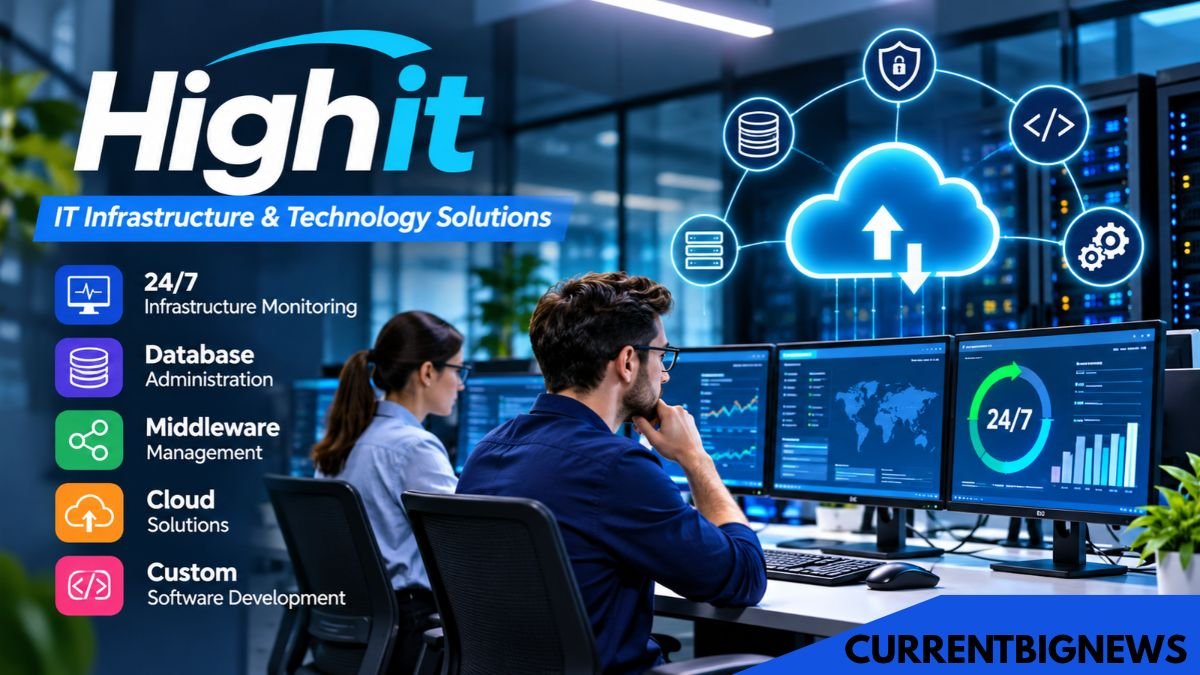
Highit is associated with Highit Service, an information technology company focused on infrastructure management, system monitoring, database administration, cloud solutions, and software development. The company presents its services as a way for organizations to maintain the systems that support everyday business operations.
As businesses become increasingly dependent on digital applications, reliable infrastructure management has become an important operational concern. Problems with servers, networks, databases, or software can interrupt customer services, delay employees, and add costs.
Highit provides operations services in Mexico and Brazil, with particular attention to organizations that depend on critical technology environments.
This article explains the company’s background, principal services, monitoring approach, potential business applications, and important considerations for organizations evaluating its technology solutions.
What Is Highit?
Highit refers to Highit Service, a technology services provider specializing in the infrastructure that supports business applications and digital operations.
Unlike a company that sells only one software application, the provider advertises several interconnected technical services. These cover infrastructure monitoring, database management, middleware, cloud technology, and customized software development.
The company’s website identifies Mexico and Brazil as its operating markets and describes more than ten years of experience in IT infrastructure.
These experience figures are company-reported statements, not independently audited performance measurements.
The business also highlights critical operating environments, including hospitals, where technology interruptions can interfere with important administrative and operational processes.
Its main focus is helping organizations manage the systems they depend on, though the specific services provided to each customer depend on individual agreements.
Highit Service: Company Background and Technology Focus
Highit Service presents itself as an infrastructure specialist built around technical expertise, practical experience, and continuous innovation.
Its published company information lists an office in Mexico City and describes a service approach intended to support operational continuity.
Operational continuity means maintaining essential business processes when technology problems occur. It involves identifying critical systems, recognizing and anticipating potential failures, and preparing appropriate recovery arrangements.
For example, a hospital may depend on several connected applications to manage scheduling, administrative records, and communication. If one supporting database becomes unavailable, employees may struggle to complete otherwise routine tasks.
Technology management providers can help organizations identify such dependencies and establish maintenance procedures.
However, a company’s advertised experience should not automatically be interpreted as proof of specific uptime results, security certifications, or guaranteed recovery times.
Businesses should assess documented capabilities and contractual commitments before selecting any provider.
Main Highit IT Infrastructure Services
The company’s published service portfolio covers five principal areas. Each addresses a different part of the technology environment, although organizations may need several services working together.
24/7 Network Operations Center Monitoring
One of Highit’s central advertised offerings is continuous Network Operations Center monitoring.
A Network Operations Center (NOC) is a function responsible for observing the condition and performance of technology infrastructure.
Monitoring may cover servers, networks, applications, and other connected systems. Technical teams use performance information and alerts to identify unusual behavior or service interruptions.
Consider a business application that suddenly begins responding slowly. Monitoring tools may indicate that the database server is consuming excessive resources or that a network connection is experiencing problems.
Early detection helps technical staff investigate issues before they become more serious disruptions.
Nevertheless, continuous monitoring does not automatically mean that every issue will be resolved immediately. Response procedures, staffing arrangements, and resolution responsibilities must be defined separately.
Database Administration and Performance Management
Databases store information used by websites, applications, business platforms, and internal systems.
Highit Service offers database administration, including performance optimization, maintenance, security, backup planning, and recovery support.
A poorly maintained database can create problems even when the surrounding application appears functional. Slow queries, insufficient storage, and configuration errors may gradually reduce performance.
Professional database management generally involves monitoring resource consumption, reviewing configuration, maintaining access controls, and identifying potential performance bottlenecks.
Backup and restoration processes are equally important. Creating a backup is only part of protecting business information; organizations also need to confirm that the information can be restored successfully when needed.
The provider’s precise database technologies, supported versions, and recovery commitments should be confirmed during a technical assessment.
Middleware Management and Application Integration
Middleware is software that helps different applications, databases, and systems communicate.
Modern businesses frequently operate several connected platforms. A retail organization, for example, might use separate systems for orders, inventory, payments, and customer communication.
Middleware allows information to move between these systems through defined processes.
Highit includes middleware management within its technology services, describing support for application stability, integration, and performance.
Effective middleware management helps technical teams identify failed connections, investigate message-processing delays, and maintain critical integrations.
However, an integration’s effectiveness depends on more than the middleware itself. Application compatibility, configuration, network access, data quality, and appropriate security controls also matter.
Businesses should confirm which integration platforms are supported and how responsibility is divided between the provider and internal development teams.
Cloud Infrastructure and Business Scalability
Cloud computing allows organizations to access computing resources without maintaining every supporting system on their own premises.
Highit Service advertises cloud solutions involving infrastructure management, availability, backup arrangements, and scalable computing resources.
Scalability is particularly important for organizations whose demand changes over time.
An online business may experience higher traffic during seasonal promotions. A properly designed cloud environment can provide additional resources when demand increases, although the available flexibility depends on the technical architecture.
Cloud services can also introduce challenges involving expenditure, security, access permissions, and data management.
Moving business systems to a cloud environment does not automatically eliminate operational risk.
Organizations still need to understand their responsibilities for configuration, application security, backups, monitoring, and recovery.
The specific cloud platforms and services supported by the company should be established through its current technical documentation.
Custom Software Development
The provider also lists software development as a principal service.
Custom development involves creating or modifying applications to meet particular business requirements.
A company might need an internal reporting platform, an application connecting existing systems, or software that supports a specialized operational process.
Before beginning development, businesses should define the problem they want to solve and determine whether an existing product could meet their requirements.
A successful project usually depends on clear specifications, realistic delivery planning, testing, documentation, and ongoing maintenance.
Organizations evaluating Highit for development work should ask about project ownership, source-code access, testing methods, maintenance arrangements, and integration requirements.
These considerations are especially relevant when a new application will become an essential part of daily business operations.
How Highit Infrastructure Monitoring Supports Businesses
Infrastructure monitoring is useful because many technical problems begin before users notice a visible failure.
A server may approach its storage limit, a database may experience unusual demand, or an application may begin producing repeated errors.
Monitoring systems can collect operational measurements and notify technical teams when predefined conditions occur.
The important distinction is between detecting a problem and resolving its underlying cause.
A monitoring alert can reveal that a service is unavailable. It does not necessarily explain whether the problem originated in the application, database, operating system, network, or another dependency.
Technical investigation is still required.
For organizations considering Highit’s monitoring services, the practical questions concern alert accuracy, response procedures, reporting frequency, and the authority assigned to support engineers.
Monitoring can improve visibility, but its value depends on how organizations respond to the information collected.
Highit and Technology Support for Critical Environments
The company identifies critical operating environments as a key area of its experience.
These environments may include organizations where prolonged technology interruptions create substantial operational difficulties.
Healthcare is one example the company mentions in its published materials.
Hospitals and other healthcare organizations often use interconnected digital systems to coordinate administrative functions, manage information, and support communication.
Infrastructure reliability matters because failures can interrupt established workflows.
However, organizations in regulated sectors require additional attention to data protection, access controls, incident management, and applicable legal requirements.
A provider’s general description of security-focused services should not be interpreted as proof of compliance with any particular industry standard.
Potential customers should request relevant certifications, security documentation, contractual safeguards, and, where necessary, evidence of previous experience.
What Makes Highit Different From General IT Support?
Traditional IT support often involves individual users, devices, troubleshooting, and everyday technical requests.
Infrastructure management operates at a different level.
It focuses on the systems that allow multiple departments, applications, and users to function.
Highit presents its services around this infrastructure-focused model, combining monitoring with database, middleware, cloud, and development capabilities.
A potential advantage of using a provider with several related technical services is that organizations can coordinate work across different technology layers.
For instance, a performance problem might require both database optimization and application-level changes.
Nevertheless, having several advertised capabilities does not guarantee that every specialist service is included in one agreement.
Customers need to establish the exact scope of technical support and identify which responsibilities remain with their own teams.
Important Questions Before Choosing Highit Service
Selecting an IT infrastructure provider requires more than comparing service descriptions.
A business should begin by identifying its essential systems, existing technical problems, and acceptable levels of operational risk.
It should then assess whether the provider has the right expertise for those requirements.
Service Agreements and Technical Responsibilities
A service-level agreement (SLA) can define responsibilities, support arrangements, and measurable service commitments.
Important details may include monitoring coverage, incident priorities, response expectations, escalation processes, and reporting requirements.
Businesses should distinguish between response time and resolution time. Receiving an acknowledgment does not mean the underlying issue has been repaired.
Written agreements should also explain exclusions, maintenance windows, and responsibilities when third-party platforms are involved.
Security and Data Protection
Infrastructure providers may require privileged access to important business systems.
Organizations should therefore assess how access is approved, monitored, restricted, and withdrawn.
Other considerations include confidentiality, encryption, backup protection, incident notification, and the handling of sensitive information.
Security arrangements should be evaluated against the actual systems and information involved, not broad marketing claims.
Pricing and Long-Term Costs
There is no single publicly established price covering every Highit Service offering.
Costs can depend on infrastructure size, technical complexity, service coverage, and the level of support required.
Businesses should request a written quotation detailing setup work, recurring charges, additional support, software licensing, and other possible expenses.
They should also understand how pricing may change when their infrastructure expands.
Common Misunderstandings About Highit
The name can be confusing because it does not immediately explain the company’s business activities.
Highit Service should not automatically be confused with unrelated organizations using similar names or with HIIT, the common abbreviation for high-intensity interval training.
Another misunderstanding concerns continuous monitoring. Although 24/7 observation can provide around-the-clock visibility, it is not the same as guaranteed uninterrupted operation.
Similarly, infrastructure management should not automatically be treated as a complete cybersecurity service.
Monitoring and security activities may overlap, but specialized protection can require additional capabilities and dedicated arrangements.
Understanding these differences helps businesses evaluate the provider without making unsupported assumptions.
FAQs
1. What is Highit?
Highit is associated with Highit Service, an IT infrastructure company offering technology monitoring, database administration, middleware management, cloud services, and custom software development. Its services are primarily designed for business technology environments.
2. Where does Highit Service operate?
The company identifies Mexico and Brazil as operating markets and lists an office in Mexico City. Organizations elsewhere should confirm current service availability directly before entering an agreement.
3. Does Highit provide 24/7 monitoring?
Yes. The company advertises continuous Network Operations Center monitoring for IT infrastructure. Customers should confirm which systems are covered and what incident-response commitments are included.
4. Can small businesses use Highit services?
Small businesses with important applications, databases, or cloud infrastructure may find specialized technical support useful. Suitability depends on business requirements, technical complexity, available packages, and cost.
5. Is Highit a cybersecurity company?
The company describes security-related benefits within its infrastructure services. However, businesses should not assume that specialized cybersecurity activities, such as penetration testing or comprehensive incident response, are included without specific confirmation.
Conclusion
Highit is a technology services provider whose published offerings focus on infrastructure management, continuous monitoring, database administration, middleware support, cloud solutions, and software development.
Its business model reflects an important operational reality: reliable digital services depend on several interconnected technology systems functioning effectively.
The company’s stated experience in Mexico and Brazil, including work involving critical environments, provides context for its intended market. However, experience figures and service benefits should be distinguished from independently verified performance outcomes.
For organizations evaluating Highit Service, the most valuable approach is to examine technical requirements, security practices, support responsibilities, pricing, and contractual commitments.