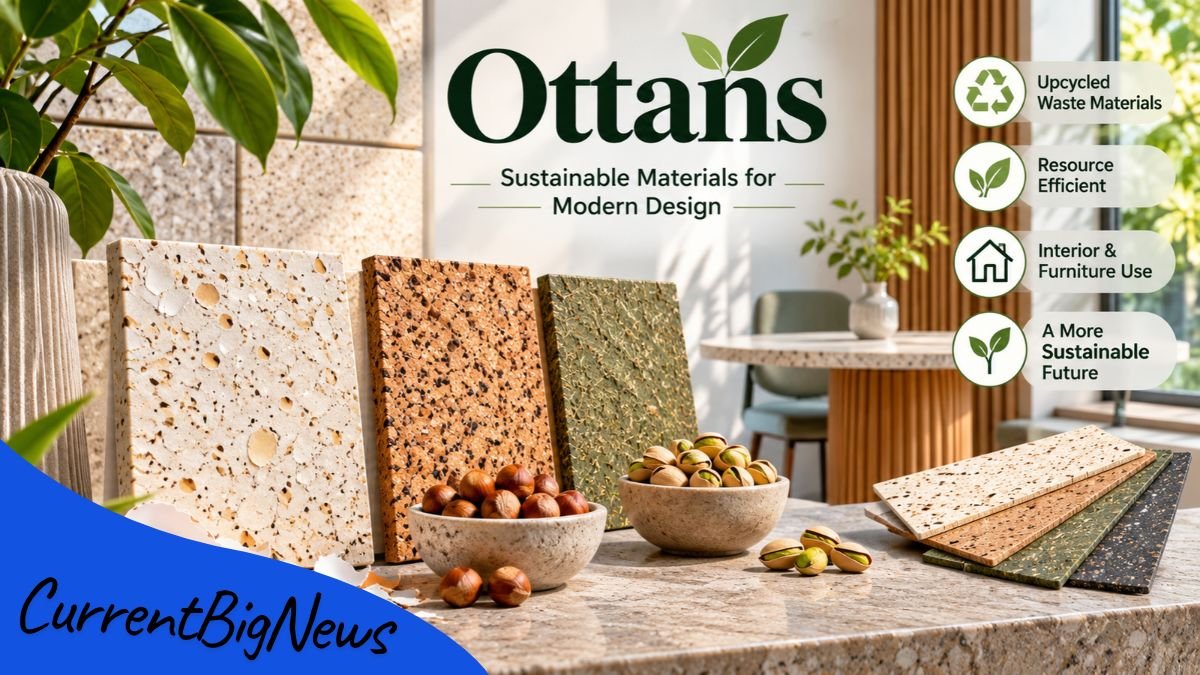
The growing demand for environmentally responsible products has encouraged designers and manufacturers to reconsider how everyday materials are produced. Ottans is a search term associated with this discussion, particularly with Ottan Studio, a business developing decorative surfaces from food and agricultural waste. Although the exact keyword has no universally recognized definition, its link to material innovation offers an interesting insight into sustainable manufacturing.
Rather than depending entirely on newly extracted resources, Ottan explores how discarded organic matter can become commercially useful products. Its approach brings together environmental responsibility, material science and contemporary interior design.
This article explains the term, its connection to Ottan Studio, the materials involved, their practical applications, potential environmental benefits, and the challenges facing waste-based manufacturing.
What Is Ottans?
Ottans is a term appearing in online discussions about sustainable materials and environmentally conscious design. In this context, it is commonly associated with Ottan Studio, a company that develops composite materials using recovered organic ingredients.
However, the official brand name is Ottan, without the additional letter “s”. The exact keyword should not be treated as an established scientific classification or the official name of a particular manufacturing process.
The central concept involves transforming discarded food and agricultural by-products into useful materials. Eggshells, nutshells, and other organic residues can become ingredients in decorative panels, furniture components, and interior surfaces.
This approach belongs to the broader field of material upcycling, where unwanted resources are converted into products with renewed practical or commercial value.
Unlike conventional waste disposal, upcycling seeks to retain the usefulness of materials that might otherwise be discarded.
The Background and Development of Ottan Studio
Ottan Studio was founded by Ayşe Yılmaz, a designer with a background in industrial design. Her work has focused on exploring how organic waste can contribute to alternative materials and aesthetically appealing products.
Design organizations, material libraries, and established news outlets have documented the company’s activities. Its development reflects a broader manufacturing shift toward resource efficiency and alternative production methods.
As environmental concerns surrounding resource extraction and waste management have increased, designers have explored ways to incorporate recovered ingredients into commercially viable products.
Ottan’s work demonstrates how materials traditionally considered waste can become part of this process. Its commercial focus extends beyond recycling alone, bringing together material development, product design, and interior architecture.
How Ottan Relates to the Circular Economy
The circular economy encourages businesses to keep products and resources useful for as long as possible. It provides an alternative to the traditional linear model of extracting resources, manufacturing products, and eventually discarding them.
Waste-based composites can support circular manufacturing by creating demand for recovered ingredients. However, genuine circularity also depends on whether finished products can be repaired, reused, or recycled after their original purpose has ended.
Ottan describes a take-back program intended to recover materials for further processing. The availability and practical conditions of such arrangements should be confirmed for individual projects.
What Materials Are Used in Sustainable Composite Products?
One of the most distinctive aspects of waste-based manufacturing is the variety of ingredients available. Ottan has documented the use of eggshells, hazelnut shells, pistachio shells and other organic by-products within its material collections.
These ingredients provide more than environmental value. Their natural colors, textures, and visual characteristics can contribute to the appearance of finished surfaces.
Eggshell-Based Materials
Eggshells contain a high proportion of calcium carbonate, making them an interesting ingredient for certain composite materials.
Ottan offers a surface called Eggy, which the company describes as an off-white, speckled material containing approximately 75% upcycled bio-based waste.
Its appearance illustrates how recovered ingredients can become visible design features rather than being concealed within a finished product. Such materials may suit contemporary interiors where natural textures and understated finishes are preferred.
Nutshell-Based Composites
Hazelnut and pistachio shells are food-processing by-products that can be incorporated into selected composite formulations.
When processed and combined with suitable binders, these ingredients can create surfaces with distinctive patterns and earthy tones.
The official Ottan product range includes collections named Nuts, Nutty, and Moon. Each collection has its own composition and visual characteristics, showing the importance of evaluating individual products rather than assuming every waste-based material performs the same.
Plant-Based Ingredients
Agricultural residues, leaves, and grass have also featured in Ottan Studio’s documented material development.
Plant-based ingredients can offer different textures and physical properties depending on their composition and preparation. Their suitability for commercial applications depends on the manufacturing method, binder, finishing treatment, and required performance.
How Ottans-Related Materials Are Produced
Manufacturing organic waste composites generally begins with identifying suitable raw materials. The selected ingredients may require sorting, cleaning, drying, and processing before they can be incorporated into a composite formulation.
A binding material helps hold the recovered particles together, allowing manufacturers to create a stable surface or shaped product.
The resulting composite may then undergo molding, cutting, sanding, or finishing, depending on its intended application.
Ottan reports that its materials contain between 60% and 95% waste by weight, depending on the individual product. The company also explains that the plant-derived content of its binders varies across different collections.
These figures are manufacturer-reported specifications. They should not be interpreted as evidence that every finished product is completely natural, biodegradable or free from synthetic ingredients.
Practical Applications in Modern Interior Design
Ottans is relevant for architects, furniture manufacturers, and interior designers exploring alternatives to conventional decorative materials.
Waste-based composites offer opportunities in spaces where appearance, functionality, and responsible material selection matter.
Furniture and Decorative Surfaces
Furniture represents a practical application for selected composite materials. Depending on their specifications, these products may suit tables, cabinet components, display units, and decorative furniture surfaces.
Their natural patterns can complement contemporary, minimalist and nature-inspired interiors.
Before selecting any furniture surface, manufacturers should evaluate its resistance to scratches, moisture, impact, and everyday wear.
Wall Panels and Interior Cladding
Decorative wall panels offer another opportunity to incorporate recovered ingredients into buildings.
Composite surfaces can add texture and visual depth to residential interiors, offices, retail environments, and commercial spaces.
However, commercial installations may require evidence of fire performance, suitable installation methods and compliance with relevant building requirements.
Kitchen and Bathroom Applications
Certain products may be suitable for countertops and other surfaces exposed to moisture. Nevertheless, suitability cannot be assumed simply because a material contains natural ingredients.
Ottan’s Eggy product information, for example, specifies an additional coating for wet environments and identifies food-contact suitability as an available option rather than a universal characteristic.
These distinctions matter most when selecting materials for kitchens, bathrooms, or hospitality environments.
Environmental Benefits of Ottans and Waste-Based Design
The potential environmental value of waste-based manufacturing begins with making better use of existing resources.
Food and agricultural processing generate by-products that may otherwise require disposal or alternative treatment. Incorporating suitable residues into commercially useful materials can add value to these resources.
Another potential advantage is reducing dependence on newly extracted ingredients. Where recovered materials successfully replace conventional raw materials, manufacturers may be able to reduce certain environmental pressures.
However, a product’s overall environmental performance depends on several factors, including manufacturing energy, transport, binder composition, durability, and end-of-life management.
A product containing a high percentage of recovered ingredients is not automatically environmentally superior to every conventional alternative.
The most meaningful comparisons consider the complete product life cycle, rather than relying on a single attractive environmental claim.
Challenges and Limitations of Waste-Based Materials
Despite their potential, alternative composites face practical challenges that manufacturers and customers must consider.
Organic waste can vary in composition, moisture content, and appearance. Maintaining consistent product quality therefore requires appropriate material preparation and manufacturing controls.
Durability is another important consideration. A decorative panel that requires frequent replacement may offer fewer long-term benefits than a conventional alternative designed for extended use.
Manufacturing costs, raw material availability, installation requirements, and recycling infrastructure can also affect commercial adoption.
Buyers should request relevant technical specifications before choosing a product. Depending on the application, these may include fire-performance information, maintenance instructions, emissions testing and evidence of moisture resistance.
Why Ottans Matters to UK Businesses and Consumers
For UK businesses, material innovation creates opportunities to explore alternative manufacturing methods and respond to growing interest in responsible consumption.
Architects and interior designers can investigate recovered-material surfaces when developing projects that prioritize resource efficiency alongside visual quality.
Consumers can also benefit from understanding the origin and composition of the products they purchase.
The UK’s Competition and Markets Authority guides through its Green Claims Code, encouraging businesses to ensure environmental statements are accurate, evidence-based, and not misleading.
This principle is particularly relevant to innovative materials marketed as sustainable, recyclable, or environmentally friendly.
The Future of Sustainable Material Innovation
The future of Ottans-related material innovation will depend on whether manufacturers can deliver reliable products that meet commercial expectations while demonstrating measurable environmental benefits.
Further development of alternative binders, improved manufacturing efficiency, and practical recovery systems could help expand the use of waste-based composites.
However, widespread adoption will require more than distinctive designs or attractive environmental messaging. Manufacturers must demonstrate consistent quality, reasonable pricing, durability, and suitability for specific applications.
The strongest opportunity lies in combining creative design with transparent product information and responsible resource management.
FAQs
1. What does Ottans mean?
Ottans is a search term used in several contexts, including sustainable material design. In this article, it refers to discussions surrounding Ottan Studio and its waste-based composite materials.
2. Who founded Ottan Studio?
Ottan Studio was founded by Ayşe Yılmaz, whose work focuses on material innovation, industrial design, and the creative use of organic waste.
3. What are Ottan materials made from?
Selected products incorporate eggshells, hazelnut shells, pistachio shells, and other recovered organic ingredients. Their exact composition and binding materials vary between collections.
4. Are waste-based composite materials waterproof?
Not necessarily. Water resistance depends on the individual formulation, finishing treatment, and installation conditions. Some products require additional protective coatings for wet environments.
5. Are Ottans materials completely biodegradable?
Biodegradability cannot be assumed from the presence of organic ingredients. The properties of the complete composite, including its binders and coatings, determine how it behaves at the end of its useful life.
Conclusion
Ottans offers an interesting starting point for understanding how recovered organic resources can contribute to contemporary material design. Its association with Ottan Studio highlights the practical possibilities of transforming food and agricultural by-products into decorative and functional surfaces.
Although waste-based composites offer potential benefits, their environmental performance must be supported by reliable evidence, appropriate technical testing and transparent product information.
The wider significance of this approach lies in reconsidering how resources are valued throughout the manufacturing process. By combining thoughtful design, material innovation and responsible production, businesses can explore alternatives to conventional resource consumption while developing products suited to modern commercial and residential environments.