


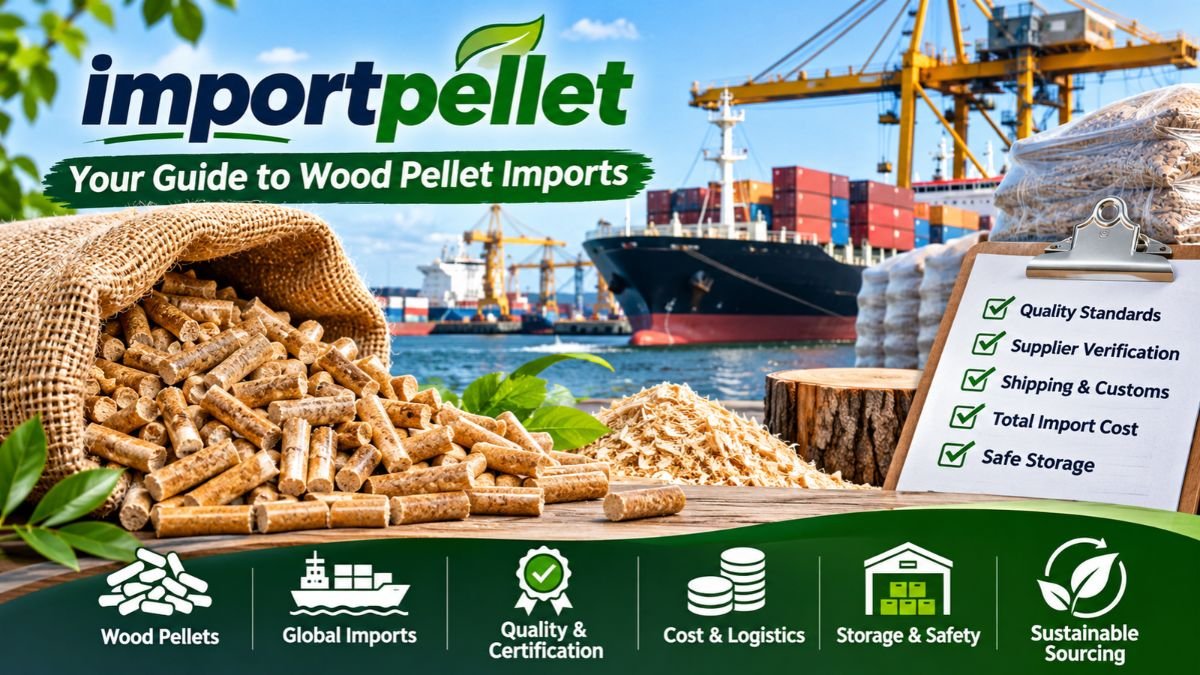
The term importpellet has attracted attention in online searches, but its meaning is not as straightforward as it first appears. Some search results link the name to a general-interest digital publication, while others discuss international trade in wood pellets used for heating and industrial energy production.
These are different subjects, and understanding the distinction is essential before relying on information about a website, supplier, or commercial opportunity.
Importing wood pellets involves more than purchasing compressed fuel from an overseas producer. Buyers must consider material specifications, quality certification, transportation, customs requirements, safe storage, and the complete cost of delivery.
This article explains what importpellet means, how the international pellet trade works, and the practical checks that help businesses make informed purchasing decisions.
What Does importpellet Actually Mean?
The word importpellet combines two familiar commercial terms: import, meaning to bring goods into a country from abroad, and pellet, referring to a small, compressed piece of material.
In the energy industry, pellets commonly refer to compressed wood fuel manufactured from suitable wood-processing materials. These products are traded internationally for use in compatible domestic heating systems, commercial boilers and industrial facilities.
However, importpellet is not an internationally recognized fuel grade, customs classification or universal certification scheme. Its meaning depends on the organization, website or commercial activity being discussed.
Recent online coverage also associates the name with a general-interest digital magazine. That publishing activity should not be confused with a business that manufactures, exports or distributes physical pellets.
Consequently, anyone researching the keyword should first identify whether the information concerns an online publication, a particular company or the broader pellet-importing industry.
Understanding the importpellet Website and Online Identity
One interpretation of importpellet concerns an online magazine described in recent coverage as publishing material about technology, celebrities, business, health and lifestyle.
In this context, the name functions as a publishing identity rather than a technical description of fuel importing. A visitor looking for articles and general information may therefore encounter content unrelated to biomass or international shipping.
This distinction matters because a website’s name does not establish its commercial purpose, ownership or authority.
Readers should examine its About section, publication dates, author information and editorial policies before treating it as a reliable source. Businesses considering advertising or publishing arrangements should also verify the relevant terms directly.
Public reporting about a website should not be treated as independent confirmation of every claim concerning its ownership, audience size, or commercial services.
The same principle applies to any company using a similar name: verify the actual business before making assumptions.
Why Wood Pellets Matter in International Trade
Wood pellets are manufactured by processing suitable woody materials into small cylindrical pieces. Raw materials can include sawdust, wood shavings, and residues from wood-processing operations.
Production generally involves preparing the raw material, reducing moisture where necessary, grinding it to a suitable particle size, and compressing it into pellets.
The resulting fuel is relatively uniform in shape, making it suitable for automated feeding equipment designed for pellet combustion.
International demand arises when consumers, distributors, or energy operators require more fuel than local producers can supply, or when imported products offer advantages in availability, specification, or commercial terms.
Wood pellets are used in several settings, including domestic pellet stoves, commercial heating installations and larger energy facilities.
Nevertheless, not every wood pellet product is interchangeable. Residential equipment may require tighter fuel-quality specifications than some industrial installations.
For this reason, successful importing begins with understanding the intended equipment and its fuel requirements.
How Importpellet Sourcing Works in Practice
The commercial process associated with importpellet begins with identifying the required product rather than selecting the cheapest overseas seller.
Before requesting quotations, an importer should establish the desired fuel grade, expected quantity, delivery frequency, packaging requirements, and final destination.
Potential suppliers may include manufacturers, exporters and specialist commodity traders. Each arrangement offers different advantages and responsibilities.
A manufacturer may provide direct information about production and raw-material sourcing. A trader may coordinate several producers or manage purchasing and logistics, but the buyer still needs to establish where the physical product originates.
Initial discussions should cover the production facility, product specifications, testing arrangements, available volumes, and contractual conditions.
Buyers should then request representative samples and relevant technical documents before committing to substantial purchases.
For unfamiliar suppliers, independent verification and a controlled first shipment can reduce the risk of receiving unsuitable material.
A credible sourcing process is based on evidence, clear agreements, and measurable quality requirements, not promotional promises.
Important Wood Pellet Quality Standards
Quality is among the most important factors in overseas pellet purchasing.
The international standard ISO 17225-2:2021 establishes specifications and quality classes for graded wood pellets intended for non-industrial and industrial applications.
It provides a technical framework for discussing fuel characteristics, rather than relying on vague descriptions such as premium or export quality.
Important parameters include:
- Moisture content: Excess moisture can reduce effective fuel performance and complicate storage.
- Ash content: Higher ash production may increase cleaning and maintenance requirements.
- Mechanical durability: Pellets that break during transportation can create excessive fines.
- Pellet dimensions: Diameter and length must match the intended equipment.
- Heating value: Energy content helps buyers compare the practical value of different fuels.
These characteristics influence how a product behaves during delivery, storage, and combustion.
An overseas supplier may describe its product as high quality, but that description has limited commercial value without defined specifications and reliable testing.
Importers should therefore agree on measurable acceptance criteria before shipment.
The Role of ENplus Certification
ENplus is a recognized certification system focused on wood pellet quality and associated production, handling and trading requirements.
Its quality classes include ENplus A1, A2 and B, with different technical limits.
For buyers considering certified pellets, an ENplus logo on a product photograph or quotation is not enough.
The supplier’s certification identity and current status should be checked through the official certification system. Buyers should also confirm that the relevant product and business activities fall within the certification scope.
ENplus focuses on technical fuel quality. It should not automatically be interpreted as proof of every environmental or carbon-saving claim.
Where sustainability verification is necessary, buyers may need additional evidence under appropriate forestry, sourcing, or sustainability schemes.
Certification is useful, but it works best alongside contractual specifications, appropriate test reports and clear delivery responsibilities.
How to Calculate the Real Cost of Pellet Imports
A major misunderstanding in pellet purchasing is that the lowest quoted price per tonne represents the best deal.
The meaningful comparison is the total landed cost, which includes the expenses required to bring the product to its agreed destination.
Depending on the transaction, this may involve factory pricing, inland transportation, export handling, ocean freight, insurance, customs charges, port fees, unloading and final delivery.
Currency fluctuations and delays may also affect the final cost.
The international delivery term chosen in the contract determines how important responsibilities are divided.
For example, under Incoterms 2020, FOB and CIF assign transportation costs and risks differently. Under CIF, the seller arranges freight and specified insurance, but the risk of loss generally transfers when the goods are loaded aboard the vessel at the shipment port.
This is why importers should not assume that freight included in a quotation means the seller carries every delivery risk until arrival.
Another useful comparison is cost per unit of usable energy rather than cost per tonne. Differences in moisture, heating value, and fuel suitability may affect a shipment’s commercial value.
Customs Documentation and Import Requirements
Businesses researching import pellet opportunities must establish which customs rules apply to their specific product and destination country.
For wood pellets, the international Harmonized System includes subheading 4401.31. However, the complete tariff classification and applicable charges must be checked against the importing country’s current customs schedule.
Customs treatment may differ for products made from other materials.
Import documentation commonly involves a commercial invoice, packing information, transport documentation and a suitable customs declaration.
Additional certificates, inspections or permits may apply depending on the type of material, its origin and the destination’s regulatory requirements.
In Great Britain, certain regulated wood materials are subject to plant-health controls, including relevant documentary and inspection requirements. Importers should confirm whether those controls apply to the specific pellet shipment rather than assuming every wood-based product follows the same rules.
A customs broker or relevant authority can clarify the requirements for an individual transaction.
Accurate paperwork reduces the likelihood of avoidable clearance delays and disagreements over declared goods.
Why Storage and Transportation Safety Matter
Pellet imports require attention to physical safety as well as commercial performance.
Wood pellets can deteriorate when exposed to unsuitable moisture conditions. Handling damage may also produce fines, affecting the delivered material and potentially creating dust-management concerns.
A less obvious issue involves gases released during storage.
The UK Health and Safety Executive has warned that stored wood pellets can release carbon monoxide, creating potentially dangerous conditions in confined storage areas. Oxygen depletion is another concern.
Accordingly, pellet stores, hoppers and bulk-handling systems require appropriate risk assessments, ventilation arrangements and safe operating procedures.
Untrained personnel should not enter enclosed pellet storage spaces without the required safety controls.
Businesses should ensure that storage facilities, handling equipment and staff procedures are appropriate for the quantities involved.
These measures protect workers and help preserve the imported product’s condition.
Environmental Considerations and Responsible Sourcing
Wood pellets are frequently discussed in connection with renewable energy, but their environmental performance cannot be established from the word biomass alone.
Overall impact depends on factors including raw-material sourcing, forest management, processing energy, transportation, and how the fuel is used.
Using suitable wood-processing residues may differ environmentally from sourcing material that creates additional pressure on forests.
Likewise, emissions from shipping and manufacturing are part of a meaningful lifecycle assessment.
Buyers should investigate the origin of the raw material and request credible evidence to support sustainability claims.
A quality certificate does not automatically establish a particular carbon footprint.
Responsible sourcing therefore requires considering both the fuel’s physical quality and the environmental consequences of its supply chain.
Practical Steps for Choosing a Reliable Supplier
For businesses exploring importpellet-related purchasing, supplier evaluation should follow a structured process.
First, confirm the supplier’s legal identity and establish whether it manufactures the pellets or acts as an intermediary.
Next, request product specifications, current test documentation, and relevant certification details. Important claims should be checked independently where practical.
The proposed agreement should identify the product, quantity, quality limits, shipment arrangements, delivery terms, and dispute-resolution procedures.
For substantial or initial shipments, independent inspection can provide additional protection.
Payment arrangements also deserve attention. Buyers should confirm banking information through a reliable channel and avoid relying solely on unexpected email changes.
Finally, assess the shipment after delivery. Comparing actual product performance with the contracted specification provides useful information for future orders.
A supplier relationship becomes more dependable when commercial promises are consistently supported by documented results.
FAQs
1. What is importpellet?
The term can refer to information about importing international pellets, particularly wood pellets used for heating and energy. It is also associated with an online publishing identity, so the intended meaning depends on the context.
2. Is importpellet a recognized pellet certification?
No. The term itself is not an internationally recognized fuel-quality certification. Buyers should examine established systems such as ENplus and relevant ISO specifications when assessing wood pellet quality.
3. What types of pellets are commonly imported?
International trade includes wood pellets, agricultural biomass pellets, plastic pellets, and other compressed materials. Their applications and regulatory requirements differ, so they should not be treated as interchangeable products.
4. How can buyers verify imported wood pellets?
Buyers can review technical specifications, recent laboratory results, certification status, and supplier credentials. Independent inspection and clearly defined contractual acceptance criteria may provide additional assurance.
5. What is the biggest risk when importing wood pellets?
No single risk applies equally to every transaction. Common concerns include unsuitable quality, unreliable suppliers, transportation damage, unexpected costs, regulatory issues, and unsafe storage conditions.
Conclusion
Importpellet is a term whose meaning depends on the context in which it appears. Online coverage links it to a digital publication, while other uses refer to the international sourcing and movement of pellet products, particularly wood-based fuels.
For readers investigating the website, the priority is to determine its actual purpose and carefully evaluate its published information.
For businesses interested in pellet imports, the key considerations differ. Product specifications, verified certification, supplier credibility, customs requirements, shipping terms, and safe storage all affect a purchase’s success.
The strongest commercial decisions come from comparing documented quality and total delivered value, not from relying on an attractive headline price.
Understanding these distinctions makes importpellet-related information more useful and helps buyers approach international pellet sourcing with greater confidence.