


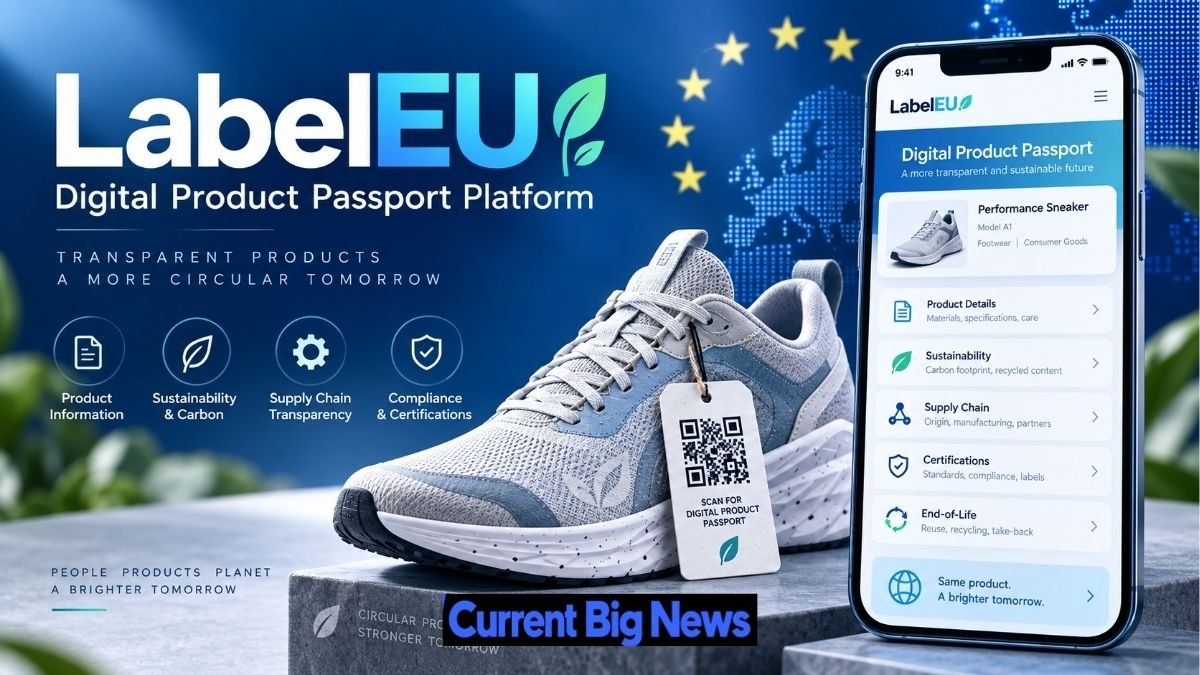
LabelEU is a software platform built around the European Union’s emerging Digital Product Passport system. Businesses searching for the service usually want to know whether it can help them organize product information, generate QR-linked passport pages, and prepare for requirements under the Ecodesign for Sustainable Products Regulation and related EU legislation.
The service presents itself as an operational compliance tool rather than a certification body or legal adviser. Its public materials focus particularly on batteries, textiles, furniture, and toys, while stressing an important point: not every product category is already subject to a binding passport deadline. That distinction matters because the EU is introducing Digital Product Passport obligations in stages.
What Is LabelEU?
The platform describes itself as Software-as-a-Service for creating, managing, and publishing Digital Product Passports, often abbreviated as DPPs. A DPP is a structured digital record connected to a product through a data carrier such as a QR code. Depending on the applicable rule, it can contain product identity, materials, origin, environmental information, compliance data, recycling guidance, and traceability details.
In practice, the service turns that concept into a workflow. Businesses can enter product data, create a passport page, generate a QR code, and prepare labels without building the technical system themselves. Public materials also describe CSV or spreadsheet importing, Shopify-related importing, API access, branded label design, and print-ready PDF export.
This article concerns the current labeleu. Digital Product Passport service. Similarly named older websites or businesses should not automatically be treated as the same entity.
Why Digital Product Passports Matter
The legal foundation is Regulation (EU) 2024/1781, the Ecodesign for Sustainable Products Regulation. It establishes the broader DPP framework, including rules around persistent product identifiers, data carriers, interoperability, and access to information. Crucially, that framework does not mean every product sold in the EU already needs a passport. Product-specific requirements generally become mandatory when the relevant delegated act or other applicable legislation makes them binding.
That is why the service distinguishes fixed deadlines from product groups still awaiting detailed rules. Companies can sensibly prepare supplier, material, certification, and lifecycle data now, but preparation should not be confused with a legal obligation that applies to every category today.
The European Commission launched the Digital Product Passport Registry on 20 July 2026. It stores unique identifiers and related metadata while underlying passport information remains decentralized, giving businesses official infrastructure for DPP implementation.
How LabelEU Works for Businesses
A typical workflow starts with product information. A company selects a category and enters relevant details such as materials, identifiers, manufacturer information, origin, environmental data, certifications, care instructions, or recycling information. The system then organizes those inputs into a digital passport page accessible via a QR code.
For companies with many products, the service may be useful because it reduces repeated manual entry. Its public materials describe bulk import options and integrations intended to bring existing product information into the passport system. The label editor also helps businesses place QR codes and branded information on physical labels.
LabelEU, Data Accuracy, and Responsibility
The most important limitation is simple: software cannot correct inaccurate source data. The platform states that manufacturers or other economic operators remain responsible for the information they provide. That means a DPP system can structure fields, flag missing information, and simplify publishing. Still, it cannot independently prove that every supplier declaration, material percentage, environmental figure, or certificate is accurate.
A sound process therefore needs internal controls. Companies should know who owns each data field, where supporting documents are stored, how supplier updates are checked, and who approves changes. A polished passport cannot compensate for weak underlying information.
Which EU Deadlines Are Most Important?
The nearest major requirement concerns certain batteries. Under Regulation (EU) 2023/1542, from 18 February 2027, each light means of transport battery, electric-vehicle battery, and industrial battery with a capacity greater than 2 kWh must have a battery passport. The regulation also requires QR codes for batteries from that date, although the information they provide differs by battery type.
For companies in these sectors, the platform can support preparation and publishing, but businesses still need to verify legal scope, required identifiers, data fields, conformity duties, and record-keeping obligations. Software does not replace the regulation itself.
Toys have a different timetable. Regulation (EU) 2025/2509 creates a Digital Product Passport for toys and applies from 1 August 2030. The passport is tied to the toy model and includes specified compliance and traceability information. Transitional provisions apply to products placed on the market under the earlier framework.
Textiles and furniture remain dependent on future product-specific ESPR measures. Preparing data may still be useful, but do not present projected dates as binding law.
Where the Platform May Be Most Useful
The strongest use case is a business whose product data is scattered across supplier emails, spreadsheets, certificates, ERP systems, and technical files. A dedicated passport platform can bring that information into a more consistent structure.
A DPP can also put relevant product information behind a single scannable code. Its value depends on whether the data is accurate, current, understandable, and accessible only to authorized audiences.
Guided forms, label tools, and imports can lower the technical barrier for teams that do not want to build DPP infrastructure. Businesses should still compare data portability, hosting, export options, security controls, support, and regulatory updates.
Privacy, Security, and Data Handling
According to its published privacy policy, the service collects account details and product information needed to operate the platform. Product data may include SKUs, identifiers, manufacturer details, material composition, environmental information, certifications, care instructions, and recycling information. The policy also describes how it handles personal account information separately from product data.
Businesses should perform due diligence before uploading commercially sensitive information. Some passport fields may be public while others can be restricted under applicable rules, so companies should understand access rights, hosting, exports, retention, and provider-switching arrangements.
Pricing and Current Availability
The current pricing page presents intended passport-pack prices but states that paid packs are not being sold at the moment. It says users can create up to three draft passports for free, while publishing and paid passport packs are currently paused. The listed prices should therefore be read as planned pricing rather than an active offer available for immediate purchase.
Anyone evaluating the platform for an immediate production rollout should confirm the current publishing status first. A useful editor or draft environment is not the same as guaranteed live deployment at scale.
What Businesses Should Check Before Relying on LabelEU
First, identify which law applies to the product. Is a passport required now, required on a fixed future date, or dependent on a delegated act that has not yet been adopted? That answer determines urgency.
The second step is data readiness. Businesses should identify data owners, map required identifiers, validate supplier documents, define update approvals, and test exports and portability because DPP information may need to remain accessible for years.
Finally, companies should distinguish compliance support from compliance certification. The software can help structure and publish information, but using the platform does not itself prove that a product complies with all applicable EU requirements. Legal responsibility remains with the relevant economic operator under the governing legislation.
FAQs
What is labeleu used for?
It is a software platform for creating and managing Digital Product Passports. It helps businesses organize product information, build QR-linked passport pages, and prepare data for EU product-compliance workflows.
Does every EU product need a Digital Product Passport now?
No. The ESPR creates a general framework, but product-specific duties depend on delegated acts or separate legislation. Certain batteries have a binding passport date of 18 February 2027, while the new toy passport framework applies from 1 August 2030.
Can the platform guarantee legal compliance?
No software platform can replace the legal responsibilities of manufacturers and other economic operators. It can help organize and publish required information, but compliance still depends on accurate data and the rules applying to the product.
Is LabelEU currently selling paid passport packs?
Its pricing page currently says passport packs are not on sale. Users can create free draft passports, but businesses should verify live publishing availability before planning a rollout.
Is the platform the same as every similarly named website?
Not necessarily. This article refers specifically to the current Digital Product Passport service at labeleu.app. Check similar names found in older search results separately.
Conclusion
LabelEU is best understood as a Digital Product Passport software platform that helps businesses organize product data, create QR-linked passport pages, and prepare for evolving EU requirements. Its practical value lies in combining data entry, imports, label tools, and structured passport publishing in one workflow. The regulatory context is equally important: the EU has established the DPP framework and launched its registry, but obligations still differ by product category. Certain batteries face the nearest major deadline on 18 February 2027, while the toy passport regime applies from 1 August 2030. Businesses considering the service should begin with the law that applies to their products, verify their underlying data, and treat the software as an operational aid rather than proof of compliance.