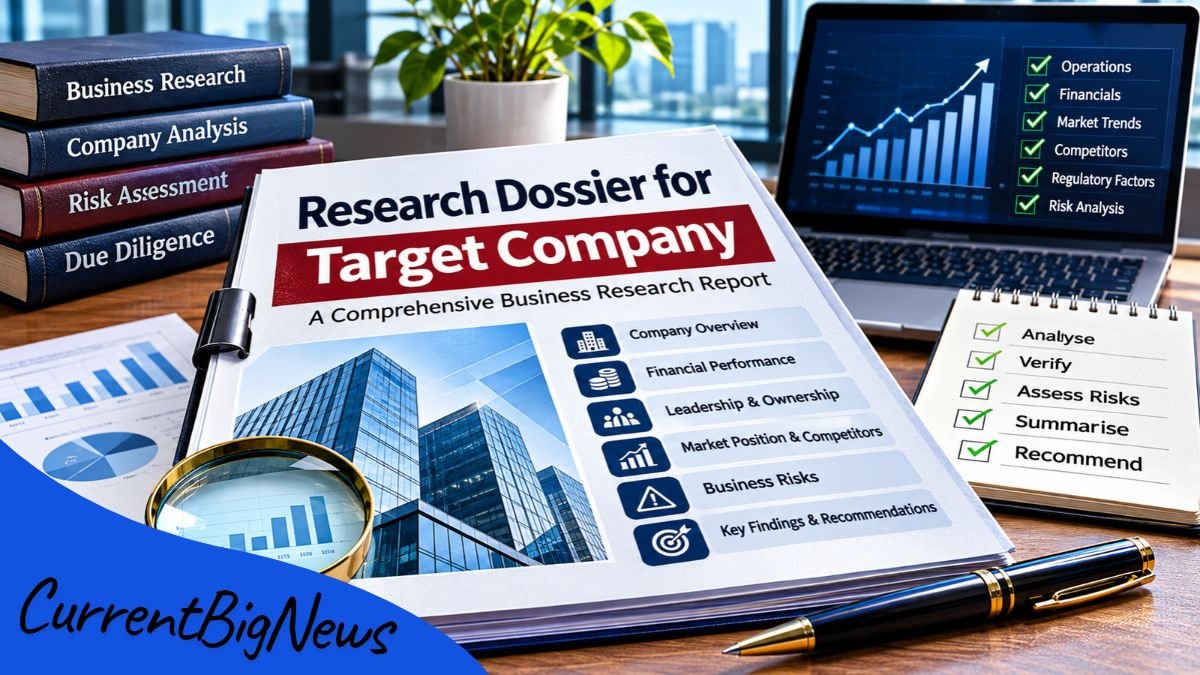
A research dossier for target company analysis is a structured collection of verified information that helps businesses, investors, analysts, and decision-makers understand an organization before making important commitments. Rather than relying on promotional claims or surface-level company descriptions, a well-prepared dossier examines corporate identity, ownership, financial performance, management, market position, and potential risks.
This research process is particularly valuable when evaluating acquisition opportunities, establishing partnerships, selecting suppliers, or studying competitors. It brings information from different sources into one organized document, making complicated business decisions easier to assess.
Building an effective company research dossier requires more than collecting facts. It involves evaluating source reliability, recognizing information gaps, and presenting findings in a clear, balanced, and useful format.
What Is a Research Dossier for a Target Company?
A research dossier for target company evaluation is a comprehensive business intelligence document that examines a particular organization. It combines available corporate records, operational information, financial disclosures, market research, and risk indicators into a structured report.
Unlike a basic company profile, which typically highlights background information and products, a research dossier investigates how a business operates, what influences its performance, and which factors may affect its prospects.
The document can support several professional activities, including corporate acquisitions, investment screening, competitor analysis, supplier evaluation, and strategic business development.
An effective research dossier for target company assessment should distinguish between verified information, reasonable analytical interpretations, and unavailable details.
The objective is not simply to collect information but to establish a reliable basis for making informed business decisions.
Why Is a Research Dossier for Target Company Important?
Business decisions frequently involve uncertainty. An organization may appear commercially successful through advertising, public announcements, or industry visibility, but these indicators alone cannot establish its financial strength or operational reliability.
A research dossier for target company evaluation helps reduce uncertainty by examining evidence from multiple perspectives.
For investors, it may reveal major financial obligations, management changes, or weaknesses in revenue generation. For procurement teams, it can highlight operational dependencies, regulatory considerations, and supplier-related risks.
Business development professionals can use the findings to understand an organization’s priorities, competitive challenges, and potential partnership opportunities.
The process also encourages accountability. When researchers document where information originated and when it was published, decision-makers can distinguish substantiated findings from assumptions.
Although no research document can eliminate commercial risk, a carefully prepared dossier can make important uncertainties easier to identify and investigate.
How to Prepare a Research Dossier for Target Company
Creating a useful research dossier for target company assessment requires a systematic approach. Start with a clearly defined purpose rather than an indiscriminate collection of company information.
For example, an investment assessment requires greater attention to financial performance and business sustainability, while supplier screening may prioritize operational capacity, security, and contractual reliability.
1. Identify the Company’s Legal Identity
The first step is establishing exactly which legal entity is being investigated.
Researchers should examine the organization’s registered name, incorporation jurisdiction, company registration number, legal status, and available ownership information.
These details are important because businesses sometimes operate under trading names that differ from their registered corporate identities.
In the United Kingdom, Companies House provides access to company registrations, filing histories, and certain officer information. In the United States, the Securities and Exchange Commission maintains EDGAR, a public database containing disclosures submitted by companies subject to SEC filing requirements.
However, registration does not automatically establish financial credibility or commercial trustworthiness. Public records may contain incomplete or outdated information, and the accuracy of individual filings must be considered carefully.
2. Examine the Business Model and Operations
Understanding how the target organization generates revenue is fundamental to business research.
This section should explain its principal products or services, customer segments, distribution channels, geographic markets, and operating structure.
Researchers should also investigate whether the company depends heavily on particular customers, suppliers, technologies, or regions, where reliable information is available.
Such dependencies can influence operational resilience and commercial stability.
A business with several revenue streams may face different risks from one dependent on a single product category. However, diversification alone does not establish financial strength.
A research dossier for target company evaluation should explain these distinctions without presenting assumptions as confirmed findings.
3. Review Financial Performance
Financial analysis is often one of the most important components of a company research report.
For organizations that publish detailed financial statements, researchers can examine revenue, operating profit, cash flow, liabilities, and financial trends across reporting periods.
Annual and quarterly reports may also reveal management commentary, financing arrangements, and disclosed business risks.
For US public companies that submit the relevant filings, Form 10-K generally provides annual financial statements and risk disclosures, while Form 10-Q presents quarterly information.
Private companies may disclose substantially less financial information.
When reliable figures are unavailable, researchers should acknowledge that limitation instead of substituting unsupported estimates.
Revenue growth should never be treated as equivalent to profitability or positive cash flow. Each measure provides different information about financial performance.
4. Investigate Leadership and Ownership
Leadership structure can influence corporate strategy, operational decisions, and governance standards.
A research dossier for target company assessment should identify publicly documented directors, senior executives, and significant ownership relationships where the information is relevant and lawfully available.
Researchers may examine leadership experience, disclosed appointments, executive changes, and corporate governance arrangements.
Frequent management changes can justify further investigation, but they do not, by themselves, demonstrate misconduct or organizational instability.
Similarly, complex ownership arrangements are not automatically suspicious. Their significance depends on the company’s circumstances and the available evidence.
The research should remain focused on professional roles and legitimate business considerations rather than unnecessary personal information.
5. Evaluate Competitors and Market Position
A company cannot be understood properly without examining the environment in which it operates.
Competitive analysis explores major industry participants, customer alternatives, pricing strategies, market trends, and potential barriers to growth.
Researchers should compare businesses with similar products, customer groups, and operating models instead of selecting competitors solely because they operate in the same broad sector.
Useful questions include whether the target organization possesses a defensible competitive advantage, faces substantial customer switching costs, or operates in a highly concentrated market.
Market share figures should be used only when their methodology, geographic scope, and measurement period are sufficiently clear.
Where market data is incomplete, qualitative comparisons can be more responsible than unsupported numerical rankings.
Reliable Information Sources for Company Research
The accuracy of a research dossier for target company analysis depends heavily on the quality of its underlying information.
Official regulatory filings, government registers, audited financial statements, and formal corporate disclosures are generally important starting points.
Company websites and investor presentations can explain products, strategy, and management priorities. However, they represent information published by the organization itself and should not automatically be treated as independent verification.
Established financial publications, reputable industry reports, and documented regulatory announcements may provide additional context.
Information should be checked for accuracy, relevance, and publication date.
How to Verify Conflicting Information
Researchers may encounter different revenue figures, ownership descriptions, or employee estimates across available sources.
Such inconsistencies do not necessarily indicate deliberate deception. They may result from different reporting periods, accounting definitions, corporate structures, or estimation methods.
The appropriate response is to identify the difference and investigate its origin.
For every material claim, an evidence record should ideally include the source, reporting date, relevant entity, and any limitations.
This approach makes the dossier easier to review and update when new evidence emerges.
Identifying Business Risks and Warning Signs
Risk assessment transforms company research into practical decision-making information.
A useful research dossier for target company evaluation should consider financial, operational, regulatory, cybersecurity, and reputational risks according to the purpose of the investigation.
Financial concerns may include persistent losses, liquidity pressures, or significant debt obligations. Operational risks can involve supplier concentration, disruption exposure, or dependence on particular facilities.
Regulatory analysis may examine applicable licensing requirements, material enforcement disclosures, and relevant legal proceedings.
However, allegations, lawsuits, and regulatory investigations must be described accurately. An allegation is not proof of wrongdoing, and a pending proceeding should not be presented as a final finding.
Cybersecurity assessment may also be relevant when an organization handles sensitive information or provides essential digital services.
Risk findings should describe both the available evidence and the potential business consequence.
Recommended Structure for a Company Research Dossier
A professional report should present essential findings before moving into supporting detail.
An effective research dossier for target-company decisions can follow a consistent structure that lets readers find key information quickly.
The opening executive summary should explain the research objective, principal findings, major uncertainties, and recommended areas for further examination.
The company overview can then establish legal identity, business activities, ownership, and leadership.
Financial and operational sections should examine commercial performance, organizational capacity, and material dependencies. A competitive assessment should describe industry conditions and the company’s position within its market.
The final analytical sections should cover risk exposure, unresolved questions, and the implications for the original business decision.
A supporting evidence record should preserve the underlying sources, dates, and important qualifications.
The strongest dossier separates what is known, what is inferred, and what remains unverified.
Common Mistakes That Reduce Research Quality
One frequent mistake is relying too heavily on a company’s promotional materials. Although these materials may contain useful information, they rarely provide a complete picture of commercial risks.
Another problem is treating older financial information as though it represents current performance.
Company structures, management teams, and market conditions can change substantially between reporting periods.
Researchers may also confuse legal entity information with brand-level information, resulting in inaccurate ownership or financial conclusions.
Excessive detail presents another challenge. A long report filled with unrelated information can make important findings more difficult to identify.
A research dossier for target company assessment should therefore prioritize relevance, evidence quality, and clarity over document length.
How to Use Research Findings Effectively
Completing the document is only one part of the research process. Its findings must also be interpreted in relation to the intended decision.
For a potential acquisition, the report may identify financial or governance questions requiring formal due diligence.
For a commercial partnership, it may highlight alignment between business objectives while identifying operational concerns that need clarification.
Procurement teams may use the findings to determine whether additional supplier assessments or security reviews are necessary.
Importantly, public-source business research is not a substitute for formal legal, financial, tax, or technical due diligence when such specialist verification is required.
The dossier should help decision-makers determine what they know, how confidently they know it, and what further information is necessary before proceeding.
FAQs
1. What is the main purpose of a company research dossier?
Its primary purpose is to organize relevant business information into an evidence-based assessment. It helps decision-makers understand a company’s operations, financial position, competitive environment, and potential risks.
2. Who normally prepares a target company dossier?
Investment analysts, corporate development teams, business researchers, procurement specialists, and consultants commonly prepare such reports. The required depth depends on the decision being supported.
3. How long does it take to prepare a research dossier?
The time required depends on the company’s size, reporting transparency, and research objectives. A preliminary profile may require relatively limited investigation, while comprehensive analysis can involve substantial document review and specialist verification.
4. Can a research dossier be prepared for a private company?
Yes, although private businesses often disclose less financial and ownership information than publicly reporting companies. Researchers should clearly identify unavailable information and avoid presenting estimates as verified facts.
5. Is a research dossier the same as business due diligence?
No. A dossier generally organizes available evidence and preliminary analysis, whereas formal due diligence may involve confidential documents, specialist examinations, direct verification, and transaction-specific legal or financial review.
Conclusion
A research dossier for target company evaluation provides a practical framework for understanding an organization before making significant commercial decisions. By bringing together corporate records, financial information, leadership details, competitive analysis, and relevant risk indicators, it helps transform scattered information into a coherent business assessment.
Its effectiveness depends on disciplined research, reliable sources, and honest treatment of uncertainty. Publicly available information can reveal important patterns, but it cannot answer every question concerning a company’s performance, ownership, or prospects.
The most useful dossier does not attempt to create certainty where evidence is missing. Instead, it clearly distinguishes facts from analytical judgments and identifies where additional verification is necessary.
For investors, businesses, and research professionals, this balanced approach supports more informed, transparent, and defensible decisions.