


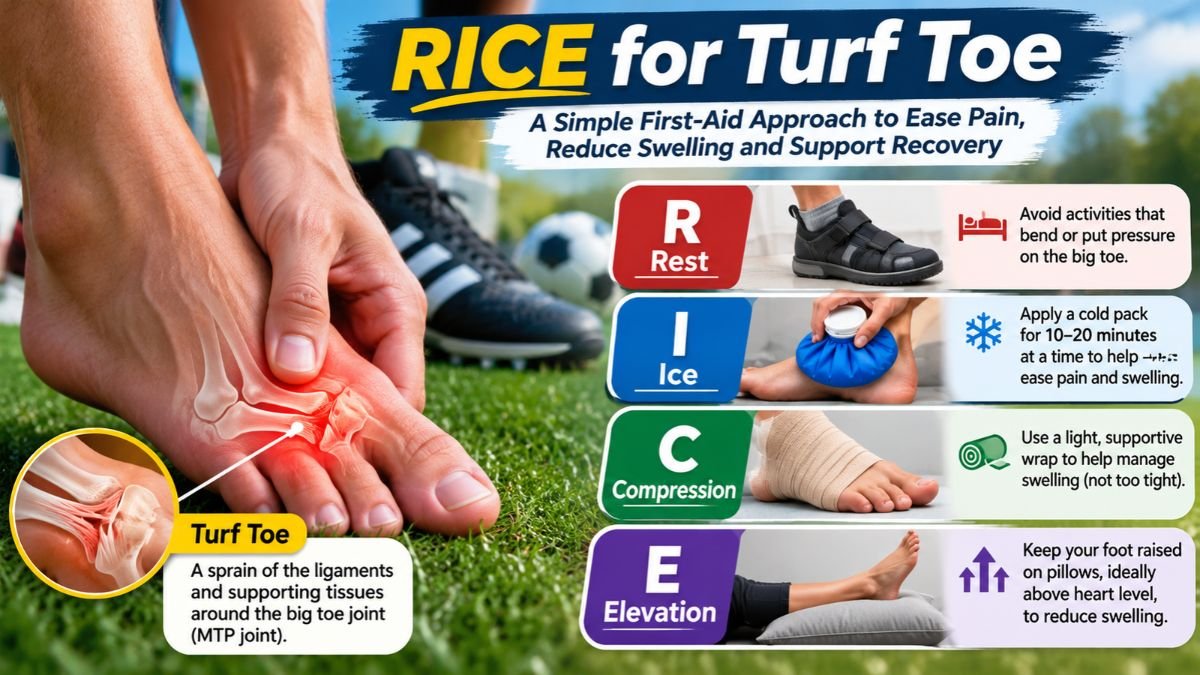
A painful big toe can make an ordinary step surprisingly difficult. When the joint is forced too far upward, the supporting tissues beneath it may stretch or tear, causing an injury known as turf toe. RICE for turf toe describes an early-care approach built around rest, ice, compression, and elevation. These measures can help manage discomfort and swelling while the injury is assessed, but they cannot repair a significant tear on their own.
The severity of the sprain matters, as does protecting the joint from repeated bending during walking or sport. Understanding how to use each step safely, when to get examined, and how to return to activity can make recovery more manageable without confusing short-term symptom relief with complete healing.
What Is Turf Toe, and Why Does It Hurt?
Turf toe is a sprain of the soft tissues supporting the metatarsophalangeal (MTP) joint, where the big toe joins the foot. It commonly occurs when the front of the foot stays planted while the heel rises and the big toe bends upward beyond its normal range. It is common in field sports but can also follow a stumble or awkward push-off. Despite the name, it is not limited to artificial turf.
Supporting structures include ligaments, the plantar plate, and small sesamoid bones. Injury can make pushing off painful, causing tenderness, swelling, bruising, restricted movement, or instability. Some people can walk; others cannot bear weight. Pain alone does not reveal the severity.
Can RICE for Turf Toe Help in the First Few Days?
The RICE approach is widely used as initial first aid for sprains. It can ease early symptoms by limiting aggravating activity and managing swelling. However, it cannot identify a partial or complete tear or replace an examination when symptoms are significant. Evidence varies among the four measures, and advice about prolonged rest and repeated icing has evolved.
Rest: Protect the Joint Without Staying Inactive Indefinitely
Rest begins by stopping the movement that caused the injury. Avoid sprinting, jumping, lunging, and repeatedly rising onto the toes, because these actions increase pressure beneath the big-toe joint. If walking causes a limp, reduce weight-bearing and ask whether a supportive shoe, boot, or crutches are appropriate. Rest protects injured tissue; it does not mean weeks of complete inactivity. Once serious damage is excluded, gentle movement can help prevent stiffness.
Ice: Use Cold for Short-Term Pain Relief
Cold packs can temporarily numb discomfort and may help control early swelling. Place a thin towel between the pack and the skin, then apply it to the sore area for approximately 10–20 minutes at a time. Use it intermittently early on; prolonged icing has not been shown to speed healing.
Never sleep with an ice pack in place, apply ice directly to bare skin, or continue if the skin becomes painfully cold, pale, or numb. For RICE for turf toe, ice is a comfort measure, not a way to speed tissue repair.
Compression: Support Swelling Without Squeezing the Toe
A light elastic bandage around the forefoot may help if swelling is noticeable, but it must not cut off circulation or force the big toe into an uncomfortable position. The toes should remain warm and their normal color, with no tingling or new numbness. Remove or loosen the wrap immediately if these symptoms appear.
Compression differs from supportive toe taping, which restricts bending and is best guided by a clinician. Avoid improvised tight splints.
Elevation: Give Swelling a Chance to Settle
When resting, support the foot on pillows so it is comfortably above heart level where possible. Elevation may make throbbing and swelling easier to manage, especially early on. If the position hurts, adjust it. RICE for turf toe is intended for early symptom relief, not as a replacement for assessment.
A Practical First-Day Plan for a Suspected Mild Sprain
If the toe hurts after you bend it upward, stop the activity, remove restrictive footwear, and inspect the foot for obvious deformity or rapidly increasing swelling. Use a cloth-wrapped cold pack briefly and elevate the foot. If swollen, consider gentle compression while maintaining normal circulation. Do not keep bending the toe to test it.
Choosing a roomy, stiff-soled shoe for necessary short walks may limit painful toe movement. Still, someone unable to walk normally needs medical evaluation rather than an improvised home treatment plan.
Remember whether a pop occurred or bruising appeared quickly; these details help with assessment. RICE for turf toe does not prove the injury is minor when swelling decreases. A partial tear may still need protection.
Understanding Mild, Moderate and Severe Turf Toe
Clinicians commonly classify turf toe into three grades.
Grade 1 means the supporting tissues have been stretched, usually causing localized tenderness and limited swelling. Grade 2 involves a partial tear and can produce more noticeable bruising, swelling, and painful movement. Grade 3 describes a major or complete tear, sometimes with joint instability or an associated bone injury. Symptoms overlap, making self-grading unreliable.
A clinician may examine joint tenderness, stability, and range of motion, and may order X-rays to look for fractures or changes in the position of the sesamoid bones. An MRI may be helpful when substantial soft-tissue damage is suspected.
Mild sprains may need supportive footwear, but serious tears can require a boot, cast, rehabilitation, or, rarely, surgery. RICE for turf toe does not treat every grade equally.
What Helps After the Initial RICE Period?
Longer-term recovery depends on protecting the joint during healing and then restoring movement and strength. A rigid forefoot insert, stiff-soled shoe, or prescribed boot can limit painful upward bending of the big toe. Supportive taping can help, but it must not restrict circulation. Moderate or severe sprains may require immobilization before exercises.
Once a clinician confirms that movement is safe, rehabilitation can focus on restoring comfortable range of motion, balance, and push-off strength. Returning to sport is not simply a matter of waiting a set number of days. Walking without limping and tolerating gradual drills matter more than a calendar date. Repeating RICE for turf toe while exercising through pain risks delaying proper care.
How Long Does Turf Toe Take to Heal?
There is no single recovery clock. Some mild sprains improve enough for ordinary activities within roughly one to two weeks, while partial tears often require several weeks. More serious injuries can take many weeks or months to recover fully, and some leave lingering stiffness or discomfort.
Recovery depends on injury severity and rehabilitation. Reduced swelling does not mean the ligaments have regained full strength.
If pain returns when pushing off, the joint may still be vulnerable. Gradual activity and supportive shoes matter more than repeating RICE for turf toe after each flare. Persistent symptoms require reassessment.
When Should You Seek Medical Attention?
Get prompt medical care if the toe looks crooked or dislocated, pain or swelling is severe, you cannot put weight on the foot, or you notice numbness, unusual color, or a cold toe. These signs may point to a problem that needs more than home care.
Worsening redness, warmth, extensive bruising or joint looseness also warrants assessment. Seek help if the toe doesn’t steadily improve after initial self-care.
This distinction matters because a fracture, significant plantar plate tear, or other injury can resemble a simple sprain at first. Someone relying only on RICE for turf toe might get temporary pain relief while overlooking damage that needs immobilization or specialist treatment.
Discuss pain medication with a clinician or pharmacist, as anti-inflammatory drugs are not suitable for everyone.
FAQs
Does RICE for turf toe work for every injury grade?
No. It can help manage symptoms early, especially in a mild sprain, but it cannot replace stabilization or treatment for a substantial tear. Moderate or severe injuries should be assessed so the joint receives the right protection.
Should I walk on my foot after turf toe?
Avoid walking through significant pain or limping. Short, necessary walks may be manageable with appropriate support in a mild injury, but difficulty bearing weight is a reason to seek medical advice.
Should I tape my big toe immediately?
Do not use tight or restrictive tape on a newly swollen toe unless you know how to apply it safely. A clinician or physiotherapist can advise whether taping, a rigid insert, or a boot is the better choice.
How long should I ice an injured big toe?
Use a cold pack with a protective cloth for about 10–20 minutes at a time for short-term relief. Stop if the skin becomes numb, unusually pale, or painful, and don’t assume longer icing speeds healing.
Can RICE for turf toe prevent another injury?
Not by itself. Returning to running or jumping before the joint has regained adequate strength and comfort can aggravate symptoms or contribute to reinjury. Gradual loading and suitable footwear help manage that risk.
Conclusion
RICE for turf toe is best understood as an early-care framework rather than a complete recovery program. Rest protects the joint from painful loading; ice can offer short-term relief; gentle compression may help with swelling; and elevation can make the first days more comfortable.
Just as important is recognizing the injury’s severity and preventing the big toe from repeatedly bending upward while its supporting tissues heal. Mild sprains often respond to conservative care, but severe pain, instability, difficulty walking, or symptoms that fail to improve need medical evaluation.
Recovery requires appropriate footwear, gradual rehabilitation, and a return to activity based on function rather than swelling alone.