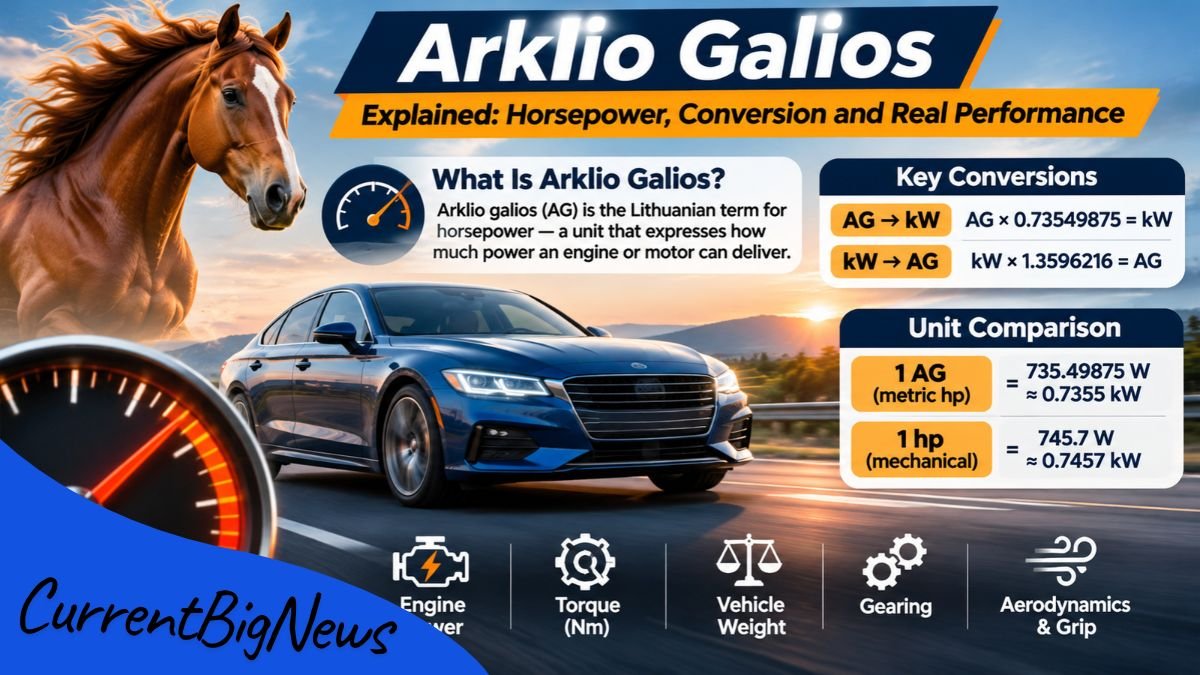
The term arklio galios appears in Lithuanian discussions of vehicle specifications, engine performance, and power conversion. It refers to horsepower, a familiar way to describe how much power an engine or motor can deliver. However, a horsepower figure does not fully describe how a vehicle will feel on the road. Cars with similar power can accelerate and tow differently.
Understanding the terminology also prevents a common mistake: Lithuanian metric horsepower, usually abbreviated AG, is not numerically identical to mechanical horsepower, commonly written hp. The distinction matters when converting figures. This guide explains the units and how to convert between them.
What Does Arklio Galios Mean?
In Lithuanian, the standard name for the unit is arklio galia, abbreviated AG. The wording arklio galios is an inflected form that also appears in searches and ordinary descriptions of engine power. In English, the concept is horsepower, a unit used to express the rate at which work is performed. It measures power, not the physical force of a horse or a vehicle’s top speed.
Power describes how quickly energy is transferred or work is done. A more powerful engine can perform work faster, which helps acceleration and hill climbing. Gearing, vehicle mass, and resistance also matter.
Why Arklio Galios Appears in Vehicle Listings
The phrase appears in Lithuanian advertisements. Sellers may show AG while official documents show kilowatts. These numbers express the same underlying power, as long as the measurement basis is comparable. Recognizing the relationship helps buyers avoid treating a larger-looking number as evidence of a stronger engine.
Where Horsepower Came From
Horsepower originated when mechanical equipment was being compared with the work performed by horses. During the industrial era, engineer James Watt popularised the term to describe the capabilities of steam engines in language customers could understand. Today, published engine ratings are determined by defined units and measurements, not by counting animals.
The term survived because it remained familiar. Engineers commonly use watts and kilowatts for standardized measurement, but vehicle marketing still relies on horsepower.
Metric Horsepower, Mechanical Horsepower and Kilowatts
The most important distinction is between two closely related horsepower definitions. One metric horsepower (1 AG) equals exactly 735.49875 watts, or approximately 0.7355 kW. It corresponds to the metric unit also called PS in German specifications and CV in some other European contexts. By contrast, one mechanical horsepower (1 hp) equals approximately 745.7 watts, or 0.7457 kW.
Mechanical horsepower is therefore about 1.4% larger than metric horsepower. The difference is small but can confuse comparisons: 150 PS and 150 mechanical hp are not exactly equivalent. The safest reference point is the figure expressed in kilowatts.
Why Arklio Galios and HP Can Show Different Numbers
When someone converts AG into English-language horsepower, the result depends on the definition used. For instance, 100 kW equals 135.96 AG or 134.10 mechanical hp. Both are correct. It is better to check the original specification than to assume every abbreviation printed as horsepower means precisely the same thing.
How to Convert Arklio Galios into kW
For Lithuanian metric horsepower, two simple formulas cover most everyday conversions:
AG to kW: AG × 0.73549875 = kW
kW to AG: kW × 1.3596216 = AG
Rounding to 0.7355 or 1.3596 is usually sufficient for vehicle advertisements. If the source instead uses mechanical hp, multiply the hp figure by approximately 0.7457 to obtain kilowatts. Do not use the AG formula for mechanical hp if an accurate comparison matters.
Practical Arklio Galios Conversion Examples
Consider a vehicle advertised at 150 AG. Multiplying 150 by 0.73549875 gives approximately 110.32 kW. A registration document showing 110 kW therefore corresponds to about 149.56 AG, commonly rounded to 150 AG in everyday discussion. Such small discrepancies may reflect rounding.
Now consider a specification listing 200 AG. That converts to approximately 147.10 kW. A different model rated at 200 mechanical hp has about 149.14 kW. The labels look similar, but the figures differ. For an estimate, multiply kW by 1.36.
Reading Engine Power on European Vehicle Documents
Many European registration certificates use the harmonized field P.2 for maximum net engine power, expressed in kilowatts, when available. A buyer checking paperwork against an advertisement should first identify that entry and then convert it using the correct unit. The displayed value may be rounded, while a model description may omit technical differences between variants.
If an advertisement claims an unusually high output, investigate the exact engine version and whether modifications have been made. Comparing the manufacturer’s original specifications, registration details, and vehicle identification information is more dependable than relying solely on an informal horsepower claim. Horsepower is useful shorthand, but it does not replace documentation.
Horsepower Versus Torque: What Is the Difference?
Horsepower measures power, while torque measures turning force, normally shown in newton-meters (Nm). Torque helps an engine produce twisting effort at its shaft; power also depends on how quickly that shaft rotates. As engine speed changes, available torque and power usually change too. The maximum torque figure and maximum power figure may occur at different revolutions per minute (rpm).
This distinction explains why a diesel vehicle with substantial low-speed torque can feel responsive without showing an exceptionally high horsepower rating. It also explains why an engine that develops power at higher rpm may need different gearing or driving technique to deliver its best acceleration. Neither torque nor horsepower alone tells the entire story; their relationship across the usable rev range matters.
Why More Arklio Galios Does Not Guarantee Faster Acceleration
Imagine two hypothetical cars. The first produces 150 AG and weighs 1,450 kg, giving roughly 103 AG per tonne. The second produces 170 AG but weighs 1,800 kg, giving about 94 AG per tonne. Despite having the higher headline power, the heavier car has a lower power-to-weight ratio. This doesn’t establish which car is faster, but it shows why Arklio Galios alone can mislead.
Acceleration also depends on gearing, grip, aerodynamic resistance, and usable power. Comparable acceleration tests give further context. A test drive remains valuable because everyday response may differ from what headline specifications suggest.
How Horsepower Applies to Electric Cars and Motorcycles
The same basic unit of power applies to petrol engines, diesel engines, motorcycles and electric motors. Electric vehicles are frequently described in kilowatts, which can be converted to metric horsepower in the same numerical way. Electric motors can produce substantial torque at low speeds, changing how acceleration feels.
For some electric models, published maximum output can depend on battery charge, temperature, operating mode, or whether the rating describes a peak rather than sustained value. Buyers should compare figures reported on the same basis. A motorcycle’s low mass can make modest power feel impressive. In each case, the rating describes output, not the entire driving experience.
How to Compare Advertised Power More Confidently
Start by checking whether the figures refer to AG, PS, mechanical hp, or kW. Convert them to one shared unit before concluding. Next, compare vehicle mass and consider the power-to-weight ratio. For daily use, torque delivery and gearbox behavior may matter more than a small peak-power difference.
Be cautious about figures from modified engines. A modified engine’s claimed output may come from a dynamometer estimate, wheel-power measurement, or different test conditions. Power measured at the wheels is not automatically equivalent to power quoted at the engine, because losses occur through the drivetrain. Be clear about the testing method before comparing figures.
Finally, consider horsepower alongside fuel efficiency, maintenance history, reliability, and intended use. Strong peak power may matter to a performance enthusiast, while predictable response, economy, and running costs may matter more to a commuter. Horsepower should be one consideration, not the sole deciding factor.
FAQs
What does arklio galios mean in English?
It refers to horsepower as a unit of power. The standard Lithuanian unit name is arklio galia, abbreviated AG, and it is commonly encountered in vehicle specifications.
How many kilowatts are in one AG?
One metric horsepower equals 0.73549875 kW, normally rounded to 0.7355 kW. Multiply the AG figure by this value to convert it to kilowatts.
Is 100 AG the same as 100 hp?
Not exactly if hp means mechanical horsepower. 100 AG is about 73.55 kW, while 100 mechanical hp is about 74.57 kW.
Why is my car’s power shown in kW on its documents?
Kilowatts are a standard unit of power and are used in European vehicle documentation. The P.2 entry commonly provides the maximum net engine power when available.
Does a higher horsepower rating mean a better car?
Not necessarily. Performance depends on mass, gearing, traction, and other factors, while suitability also depends on comfort, efficiency, reliability, and cost.
Conclusion
Understanding arklio galios makes it easier to interpret vehicle listings and compare specifications without mistaking unit differences for real performance advantages. The central fact is straightforward: Lithuanian AG refers to metric horsepower, and 1 AG equals approximately 0.7355 kW. Mechanical horsepower uses a slightly different conversion, so the two figures should not be treated as identical.
The numbers become more valuable when considered alongside torque, vehicle weight, gearing and the conditions under which output was measured. Whether you are reading a registration certificate, assessing an imported car or comparing an electric vehicle with a petrol model, convert the figures consistently and look beyond peak power. That approach turns a familiar label into a useful, practical measure.
Best Category: Technology