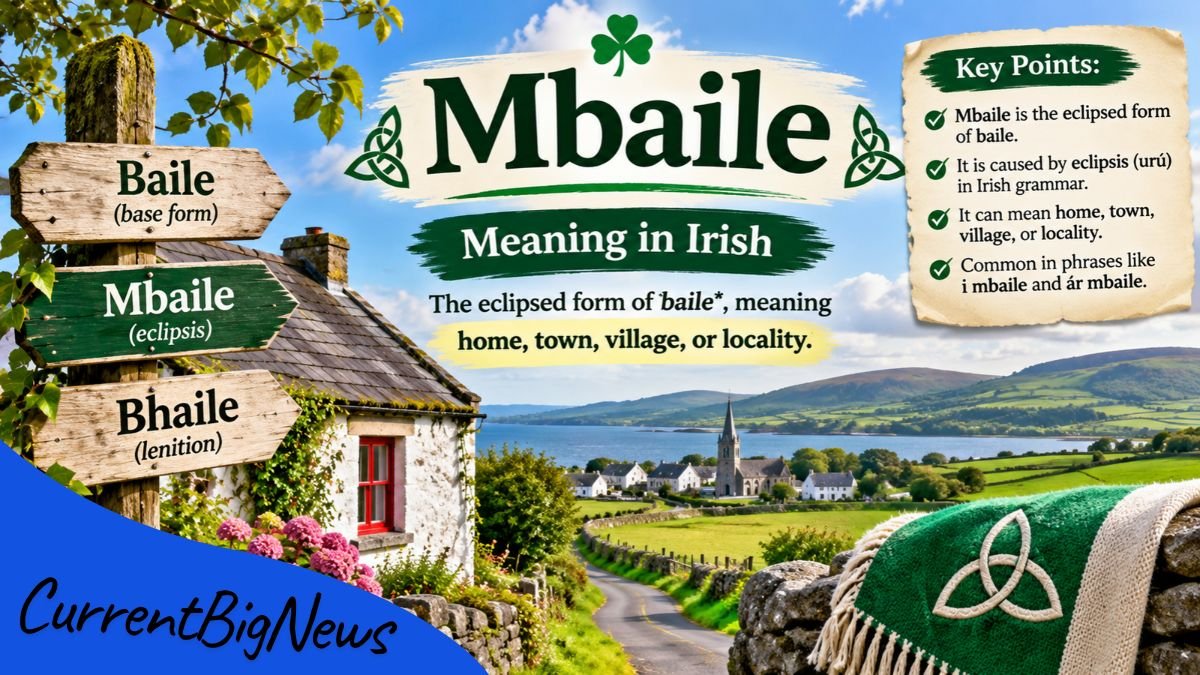
Mbaile is an Irish-language word form that can confuse readers who are unfamiliar with Gaelic spelling and grammar. Although it may look like an independent word, it is a modified form of baile, an Irish noun meaning home, town, village, or locality. Its precise meaning depends on the surrounding sentence.
The additional letter m appears because of a grammatical process called eclipsis, known as urú in Irish. This process changes the beginning of certain words according to grammatical rules.
Understanding this distinction helps readers interpret Irish expressions, place names, and everyday conversations more accurately. This guide explains the meaning, grammatical background, pronunciation, regional variations, and practical examples of the term, while addressing common misunderstandings.
What Does Mbaile Mean in Irish?
The word mbaile is the eclipsed form of the Irish noun baile. Rather than representing an entirely different word, it carries the original noun’s meaning while reflecting a grammatical change.
Irish dictionaries record several meanings for baile, including home, town, village, and townland. The intended translation depends on how the word is used. In one sentence, it may refer to someone’s home. In another, it may describe a town or the community associated with a particular location.
This flexibility matters because Irish and English do not always divide geographical and residential concepts into the same vocabulary categories.
A reader who encounters an unfamiliar expression should therefore examine the full sentence rather than translating the modified noun in isolation.
Understanding the Meaning of Baile
The original noun has a broad range of geographical and personal associations. It can describe a place where someone lives, a settlement, or a locality connected with their identity.
For example, baile mór generally means a town, while baile beag can describe a village. The expression baile dúchais refers to someone’s native place or home locality.
These examples demonstrate why a single English translation cannot cover every use of the noun.
The distinction between a physical house and a wider sense of home also matters. Irish commonly uses teach for a house, while baile can refer to the broader idea of home or community.
Why Does Baile Change to Mbaile?
One of the most distinctive features of Irish grammar is initial mutation. This means that the beginning of certain words changes depending on their grammatical environment.
The transformation from baile to mbaile occurs through eclipsis.
In this process, the letter m is placed before the initial b. The original consonant remains visible in writing, but its sound is replaced by the eclipsing consonant.
This grammatical pattern also occurs with other Irish consonants. For example, an initial c can become gc, while an initial p can become bp.
These changes are not random spelling variations. They follow grammatical rules associated with prepositions, possessive expressions, numbers, and other constructions.
Understanding how eclipsis operates makes unfamiliar Irish words easier to recognize.
How the Preposition I Creates Eclipsis
The Irish preposition i generally means “in”. When it comes directly before an appropriate consonant-initial noun without the definite article, it normally causes eclipsis.
For example, the phrase i mbaile can refer to being in a town or locality, depending on the sentence.
The preposition establishes the relationship between the person or object and the location. The modified noun reflects the grammatical requirement.
This means that the added consonant does not create a new place or change the basic meaning of the original word.
Learning the preposition and noun together is often more effective than memorizing their individual translations.
Mbaile After Possessive Words
Possessive expressions provide another useful example.
The Irish word ár, meaning “our”, causes eclipsis in a following eligible noun. Consequently, ár mbaile can mean “our town” or “our home”, depending on context.
The plural possessive bhur, meaning “your” when addressing multiple people, also triggers this grammatical process. The possessive a, when meaning “their”, follows the same general pattern.
These distinctions help communicate ownership and grammatical relationships without requiring completely different nouns.
For learners, recognizing the preceding possessive word is often the easiest way to understand why the spelling has changed.
Baile, Mbaile, and Bhaile: Important Differences
Three related spellings frequently appear in Irish: baile, mbaile, and bhaile.
Although they share the same underlying noun, their grammatical forms are not interchangeable.
Baile is the unmutated dictionary form. It appears in numerous ordinary expressions relating to towns, homes, and localities.
Mbaile represents eclipsis, where an additional consonant changes the beginning of the word.
Bhaile represents lenition, called séimhiú in Irish. With an initial b, lenition is shown by adding h immediately after the consonant.
Eclipsis and lenition are different grammatical processes. They occur in different environments and can produce different pronunciations.
Recognizing these distinctions helps learners understand written Irish without assuming that every unfamiliar spelling represents an unrelated word.
Comparing Common Irish Expressions
Consider the following examples:
I mbaile: Can refer to being in a town or locality.
Ár mbaile: Our town or our home, depending on context.
Sa bhaile: At home.
Abhaile: Homeward or towards home.
These expressions illustrate how small grammatical differences can change the meaning of a complete phrase.
For instance, Tá mé sa bhaile means “I am at home”, whereas Tá mé ag dul abhaile means “I am going home”.
The first describes someone’s location. The second describes movement towards home.
These distinctions matter most in everyday conversation.
How to Pronounce Mbaile Correctly
Pronunciation is another reason this Irish form may appear unfamiliar to English speakers.
In the eclipsed spelling, the initial mb is normally pronounced with an m sound, rather than as two separately articulated consonants.
However, the rest of the word varies by region.
Irish has several major dialect traditions, including Munster, Connacht, and Ulster. Differences in vowels and consonant qualities mean that a pronunciation heard in one region may not match another exactly.
For learners, the most reliable approach is to listen to recordings from Irish-language dictionaries and become familiar with more than one dialect.
An English approximation may help beginners, but it cannot accurately represent every Irish sound.
Understanding the grammatical relationship between the written form and its pronunciation is more useful than memorizing an oversimplified English spelling.
Mbaile in Irish Place Names
Irish place names offer practical examples of how grammatical mutations operate.
Many Irish geographical names contain the word baile, reflecting settlements, communities, or historically established localities.
One well-known example is Baile Átha Cliath, the Irish name for Dublin.
When the preposition i expresses location, the construction becomes i mBaile Átha Cliath, meaning “in Dublin”.
The added consonant shows eclipsis, while the capitalization preserves the proper-noun structure.
This example is useful because it connects a familiar modern city with an important grammatical feature of Irish.
Why Place-Name Context Matters
You cannot always translate a place name accurately by treating every component as a separate English word.
Irish geographical names often contain historical, geographical, and linguistic information that requires additional context.
A grammatical mutation does not necessarily change the identity of the location. Instead, it may indicate how the name functions within a sentence.
Readers researching Irish local history, geography, or family records can benefit from understanding these patterns.
Recognizing a word’s original form can also make dictionary searches more productive.
Is Mbaile Used in Modern Irish?
Yes. The form remains part of modern Irish grammar and appears in established expressions and contemporary language resources.
It is not simply an outdated historical spelling.
However, Irish usage is not identical across every region. Dialect differences can influence pronunciation and, in certain constructions, the mutation used.
For example, sa bhaile is the familiar standard expression meaning “at home”, while sa mbaile is also documented in some regional speech, including Cois Fharraige Irish.
This distinction demonstrates why a form encountered in regional speech should not automatically be dismissed as an error.
Understanding the relationship between standard Irish and traditional dialects provides a more accurate picture of the language.
The most useful approach is to consider both the grammatical construction and the speaker’s regional background.
Common Mistakes When Understanding Mbaile
A common mistake is assuming the word always translates directly as “home.”
Although the underlying noun can express that idea, it also refers to towns, villages, and localities.
Another misunderstanding involves treating the initial m as an indication of plurality. Eclipsis does not automatically make a noun plural. Irish has separate grammatical forms for expressing number.
Some readers also confuse the term with the English word “mobile” because of its appearance. However, its established Irish grammatical meaning is unrelated to mobile technology.
Another mistake is assuming that bhaile and mbaile are simply alternative spellings chosen by personal preference.
They represent different grammatical processes, even though regional conventions sometimes influence their distribution.
The best way to avoid these errors is to examine the surrounding words before deciding on a translation.
How to Learn and Remember the Word
For beginners studying Irish, learning vocabulary alongside its grammatical patterns is especially useful.
Start with the dictionary form baile and understand its principal meanings. Then examine how the word changes after prepositions and possessive expressions.
Practicing complete phrases is generally more helpful than memorizing isolated spellings.
A learner might begin with ár mbaile, followed by sa bhaile and i mBaile Átha Cliath. Each example reveals a different relationship between grammar and meaning.
It is also useful to compare written examples with authentic pronunciation recordings.
When checking unfamiliar vocabulary, an established Irish dictionary can help identify the base noun and clarify its different meanings.
Over time, recognizing eclipsis becomes a transferable skill. The same grammatical principles help explain numerous other words throughout the Irish language.
FAQs
1. What does mbaile mean in English?
Mbaile is the eclipsed form of the Irish word baile. Depending on the surrounding phrase, it may mean a home, town, village, or locality. The full sentence determines the best translation.
2. Why is there an M before baile?
The additional letter comes from eclipsis, an Irish grammatical process called urú. Certain constructions require the first consonant of a word to undergo this change. When the original word begins with b, it becomes mb in writing.
3. Is mbaile a separate Irish word?
It is generally classified as a grammatical form of baile rather than an unrelated noun. The added consonant reflects a grammatical rule. Dictionaries may therefore explain its meaning under the original word.
4. What does sa bhaile mean?
Sa bhaile is a common Irish expression meaning “at home”. It describes a location rather than movement towards home. Some regional varieties also use the form sa mbaile.
5. Is mbaile pronounced the same across Ireland?
Not exactly. Its initial eclipsed consonant is normally pronounced as an m sound, but other sounds vary across Irish dialects. Listening to regional recordings is the most reliable way to understand those differences.
Conclusion
Mbaile is best understood as a grammatical form of the Irish noun baile, rather than as a completely independent word with one fixed English translation. Its meaning can relate to home, town, village, or locality, depending on the expression in which it appears.
The initial m results from eclipsis, an established feature of Irish grammar that changes the beginnings of certain words. Understanding this process also makes it easier to distinguish between related forms such as baile, bhaile, and abhaile.
For anyone studying Irish vocabulary, reading place names, or translating traditional expressions, recognizing these differences is an important practical skill. The key is to consider grammar, context, and regional variation together rather than relying on isolated word translations.