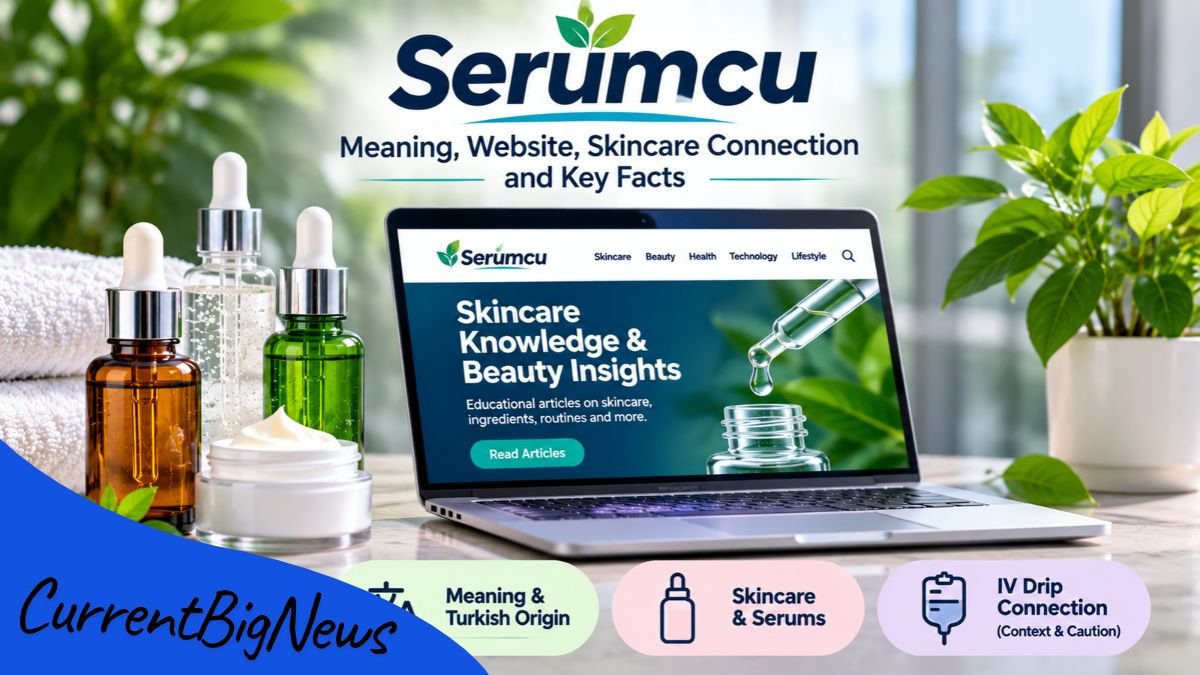
The name Serumcu has attracted attention across online searches, but understanding what it represents requires separating several different meanings. It is associated with an informational website that describes itself as a resource for skincare education, beauty ingredients, and product guidance. The name also connects to Turkish terminology, where similar wording can informally refer to someone administering intravenous fluids.
These interpretations are not interchangeable. A skincare information website, a cosmetic serum, and an intravenous medical service serve entirely different purposes.
For readers encountering the term for the first time, the most useful approach is to examine its language background, identify the existing website, and distinguish facts from unsupported online descriptions. This guide explains those differences, explores the website’s published content, and addresses practical questions about skincare advice, medical terminology, and online credibility.
What Is Serumcu?
Serumcu is an online name associated with a website that presents itself as an educational resource covering skincare, cosmetic ingredients, beauty products and personal care routines.
According to the website’s own description, it aims to help readers understand skincare products and make more informed decisions about their routines.
However, the publicly visible website covers a considerably broader range of subjects. Its homepage features articles concerning business, technology, celebrities, biographies, health and general-interest news.
This distinction matters because the site’s stated editorial focus does not fully describe its published material.
Rather than identifying the name as a specific facial serum or a recognized medical profession, it is more accurate to understand it as an online publication name with additional linguistic associations.
Insufficient independently verified information establishes that the website operates a dedicated cosmetic manufacturing business or sells a complete skincare product range under the same name.
Readers should therefore avoid confusing an informational website with evidence of a specific physical product.
Understanding the Meaning and Turkish Origin
The name becomes easier to interpret when its components are examined separately.
The first part, serum, is familiar in both English and Turkish, although its precise meaning depends on whether the discussion concerns medicine, cosmetics, or laboratory science.
The second part resembles a common Turkish word-forming suffix.
How the Turkish suffix contributes to Serumcu
Turkish uses suffixes such as -cı, -ci, -cu and -cü to form words referring to people associated with particular occupations, activities or objects.
The suffix changes according to Turkish vowel harmony and other spelling rules.
When attached to the word serum, the ending can suggest a person associated with serum-related work or services.
This is a reasonable linguistic interpretation, but it should not be confused with a formally recognized professional qualification.
In some Turkish contexts, related informal language is used for individuals who provide intravenous drips, including services delivered outside hospitals.
A person’s actual medical authority depends on their professional registration, training and applicable healthcare regulations, not the informal label used to describe them.
Why the word serum can cause confusion
In everyday cosmetics, a serum usually means a lightweight skincare formulation containing ingredients selected for particular skin concerns.
In medical science, blood serum is the liquid remaining after blood clots and the clot is removed.
In Turkish everyday speech, serum can also refer to intravenous fluids or drip treatment.
These meanings share the same term but refer to different substances and activities. Context is therefore essential before interpreting the larger expression.
What Does the Serumcu Website Offer?
The website describes itself as a source of skincare information intended to help readers understand ingredients, products, and everyday beauty routines.
Its About Us page emphasizes skincare education, accessible explanations, and informed product decisions.
However, its published content is not restricted to beauty.
Skincare and beauty information
The website’s stated editorial interests include facial serums, ingredient explanations, skincare routines and product guidance.
These topics are useful because skincare marketing often uses technical language that ordinary consumers may struggle to interpret.
For example, a reader researching a moisturizing serum may want to understand the difference between hydration, moisture retention, and treatment of an underlying skin condition.
A genuinely useful educational article should explain those differences without promising results that the evidence cannot support.
Nevertheless, a website’s description of its ambitions is not independent proof that every article has been medically reviewed.
Readers should assess individual pieces of content rather than assume all articles follow the same editorial standards.
Business, technology and general-interest articles
The homepage also displays articles covering business education, digital technology, public personalities, consumer subjects and current-interest topics.
This wider editorial range suggests that the publication functions as a general information website despite its declared interest in skincare.
There is nothing inherently unusual about an online publication covering multiple categories. The relevant question is whether each article demonstrates appropriate research, expertise, and accuracy.
Technology reporting requires different evidence from skincare guidance, while personal biographies require careful handling of identities and private information.
The quality of individual articles matters more than the breadth of a website’s subject categories.
Is Serumcu a Skincare Brand or a Particular Cosmetic Product?
One common misunderstanding is that the name necessarily identifies a facial serum available for purchase.
The available public information does not establish a clearly documented cosmetic product range manufactured under this exact name.
A website discussing serums is not automatically a cosmetic manufacturer, authorized retailer, or product developer.
Before treating an unfamiliar name as a skincare brand, consumers should look for ordinary commercial details, including an identifiable manufacturer, full ingredient declarations, product packaging and relevant seller information.
A legitimate cosmetic product should also provide appropriate usage instructions, warnings and traceability information.
Where these details are unavailable, consumers should not assume descriptions on unrelated websites verify a product’s existence or effectiveness.
The same caution applies to claims that the name represents a specialized skincare profession.
There is no established basis for treating it as an officially recognized dermatology qualification.
A qualified dermatologist, pharmacist or appropriately trained skincare professional should be identified through their actual credentials rather than an attractive online title.
Understanding Facial Serums and Their Ingredients
Although the name has several associations, the subject of skincare serums deserves explanation because it features prominently in the website’s stated purpose.
A facial serum is generally designed to deliver selected cosmetic ingredients through a formulation that may feel lighter than a conventional moisturizer.
However, the word serum does not guarantee that a product contains a particular concentration of active ingredients or offers better results than a cream.
Its effectiveness depends on the complete formulation, ingredient concentration, stability, application method, and suitability for the individual’s skin.
Common ingredients in modern skincare
Hyaluronic acid is widely used in skincare formulations because it attracts and binds water. Products containing it can help improve the skin’s hydrated appearance, although outcomes depend on formulation and environmental conditions.
Niacinamide, a form of vitamin B3, appears in products intended to support the skin barrier and address concerns such as uneven tone or excess oil.
Vitamin C is used in antioxidant skincare formulations. Certain forms have evidence supporting improvements in the appearance of pigmentation and signs of photoageing.
Retinoids, including retinol, are associated with skin renewal and may improve some concerns involving acne, texture and visible aging. They can also cause dryness or irritation, particularly when introduced too quickly.
Retinoid products should be avoided during pregnancy unless a suitably qualified clinician gives specific advice.
None of these ingredients work the same for everyone, and their presence on a label does not mean the entire product has been clinically tested.
Choosing products according to skin needs
People with dry skin may benefit from gentle, fragrance-free moisturizers that support the skin’s protective barrier.
Those experiencing oily or acne-prone skin may require a different approach, especially when choosing products containing exfoliating acids or retinoids.
Sensitive skin can react to fragrances, certain preservatives or strong active formulations. Introducing one new product at a time and checking for irritation can make it easier to identify unsuitable ingredients.
Persistent acne, eczema, unexplained rashes, or significant pigmentation changes should be assessed by an appropriate healthcare professional.
A cosmetic product may improve appearance, but it should not be presented as a substitute for diagnosis or prescribed treatment.
Serumcu and Intravenous Drip Services: An Important Distinction
In Turkish conversational usage, serum-related wording can also describe people involved in intravenous fluid administration.
An intravenous drip delivers fluids or prescribed substances directly into the bloodstream through a cannula inserted into a vein.
Doctors may recommend this treatment when a patient cannot get enough fluids through normal drinking, has substantial fluid losses, or needs medication delivered intravenously.
However, intravenous treatment is a medical procedure, not a general remedy for tiredness or everyday illness.
Suitability depends on clinical assessment, the patient’s medical history, and the infusion contents.
Are wellness vitamin drips medically necessary?
Commercial intravenous vitamin treatments are sometimes promoted for energy, beauty, recovery or general wellbeing.
These promotional claims should not be mistaken for established medical benefits.
NHS England has previously warned that commercial vitamin drips marketed as quick remedies lack convincing evidence for many of their advertised benefits.
Intravenous procedures can also cause infection, irritation, allergic reactions and complications involving fluid balance.
People with certain heart or kidney conditions may face additional risks.
For mild dehydration, drinking suitable fluids or using an oral rehydration solution is generally preferable when the person can drink safely. Severe dehydration requires urgent medical assessment.
Any home-based intravenous treatment should be provided only when clinically appropriate and by professionals authorized to carry out the procedure under the relevant local rules.
How to Evaluate the Website’s Credibility
Anyone using Serumcu as an information source should apply the same critical standards they would use for other health, beauty or general-interest websites.
A polished design, confident language, or professional-looking photographs cannot establish editorial reliability on their own.
Readers should examine whether an article identifies its author, explains important factual claims, and distinguishes established evidence from personal opinion.
Publication dates also matter, particularly for subjects involving changing technology, healthcare recommendations or consumer regulations.
Assessing editorial transparency
Useful indicators include clear contact information, identifiable editorial responsibility, meaningful correction procedures and explanations of how specialist information is reviewed.
The website provides About Us, Contact and Disclaimer pages, allowing visitors to examine its publicly stated purpose and general policies.
However, these pages should be treated as statements made by the publisher rather than independent verification of its expertise.
For medical information, readers should compare important claims with established clinical guidance and consult appropriately qualified professionals where necessary.
For consumer products, they should verify manufacturer information, ingredient labels and purchasing conditions independently.
An article can be informative without being authoritative on every subject it discusses.
Why Accurate Identification Matters
Search engines can display very different interpretations of an unfamiliar word, particularly when the same expression appears in website names, cosmetic discussions, and colloquial language.
That creates opportunities for misleading descriptions to circulate.
For example, an article may describe a supposed beauty product without identifying its manufacturer. Another may treat an informal medical expression as an official professional title.
Both approaches can create confusion when supporting evidence is missing.
The most reliable way to interpret a search result is to establish whether it concerns an actual website, a documented commercial product, a linguistic expression, or a medical service.
Readers should also distinguish the claims made by a business about itself from facts independently established by trustworthy sources.
Clear terminology helps prevent misunderstandings, especially when the subject involves consumer purchases or healthcare decisions.
FAQs
1. What does Serumcu mean?
The term is associated with an online information website and may have a Turkish linguistic interpretation involving someone connected with serum. Its meaning depends on context, and it is not established as a formal medical or cosmetic qualification.
2. Is Serumcu a real website?
Yes. A website operates under this name and describes itself as a skincare information resource. Its publicly visible articles also cover technology, business, celebrities, health, and other general-interest topics.
3. Does the name refer to a particular facial serum?
Insufficient independently verified information exists to identify a specific cosmetic product range manufactured under the name. Consumers should verify the manufacturer and ingredients of any product advertised using similar wording.
4. Is Serumcu connected with medical IV treatment?
The wording can informally connect to intravenous drip services in Turkish usage. However, a linguistic association does not mean the website provides medical treatment or that someone using the label has professional medical qualifications.
5. Can skincare information from the website replace a dermatologist?
No. General skincare articles may help explain ingredients and product categories, but they cannot diagnose skin diseases or replace personalized medical advice. Persistent, painful, or unusual symptoms should be discussed with a qualified healthcare professional.
Conclusion
Serumcu is best understood by separating its verified online presence from the wider meanings suggested by its wording. The existing website describes itself as a skincare education resource, although its published material extends into business, technology, celebrity coverage, and other subjects.
The name also resembles a Turkish expression that may describe people associated with serum or intravenous services. That linguistic connection does not create an official medical title or establish a relationship between the website and healthcare providers.
Likewise, verified evidence is insufficient to identify the name as a specific cosmetic product line.
For readers, the practical lesson is straightforward: examine the context, verify commercial and professional claims, and seek reliable medical guidance where health decisions are involved. Accurate information is ultimately more valuable than an appealing name or an unsupported online description.