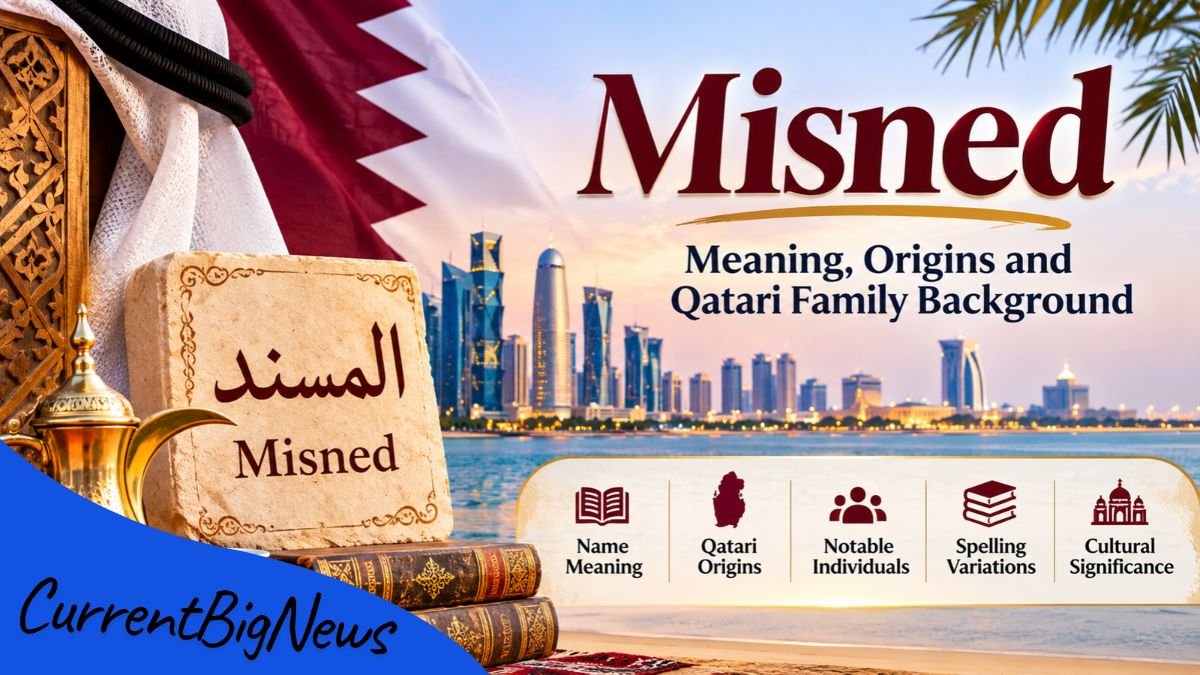
The name Misned appears in discussions of Qatari public life, education, government, and family identity. Although it may look unfamiliar to English-speaking readers, it appears in official records, particularly in Qatar and the wider Arabic-speaking Gulf region.
People searching for this term often want to understand its meaning, history, spelling variations, and connections to prominent individuals. However, distinguishing reliable information from unsupported interpretations is essential.
Official institutional records establish its use as a personal or family-name element. They do not, by themselves, establish one universal translation or a complete family genealogy.
This article explores the name’s documented background, explains its different English spellings, introduces notable individuals associated with it, and considers its cultural relevance.
What Is Misned and What Does It Mean?
Misned is primarily recognized as a surname or personal-name element associated with Arabic-speaking communities, particularly Qatar. It commonly appears in extended names, sometimes accompanied by the Arabic definite article represented in English as Al.
Unlike ordinary English vocabulary, family names do not always have straightforward dictionary definitions. Their meanings may reflect historical naming conventions, geographical associations, linguistic development, or ancestral identities.
The precise historical meaning of this particular surname has not been conclusively established through the public sources examined for this article.
Consequently, claims that it universally means wisdom, leadership, honor, or another specific quality should be approached cautiously unless supported by credible linguistic or historical evidence.
Is Misned an Arabic Name?
The name is documented in Arabic naming contexts. Related English forms, including Al-Misnad and Al-Misned, occur in Qatar’s government announcements, university records, and professional biographies.
In Arabic, the surname is commonly represented as المسند.
Its appearance in official records establishes a genuine naming connection. However, nationality, tribal affiliation, and exact family lineage cannot be determined from the English spelling alone.
Understanding Its Linguistic Background
Arabic names often contain several elements. These may include an individual’s given name, references to a parent or ancestor, and a family or tribal designation.
The words bin and bint, for example, indicate “son of” and “daughter of” in many Arabic naming conventions.
These components help explain why individuals may appear under long formal names in government publications while using shorter forms in everyday professional settings.
Understanding the full naming structure is important when researching historical personalities or comparing records.
The Origin and Cultural Background of Misned
The most clearly documented modern association of Misned is with Qatar, where related family-name forms appear across education, public administration, and professional life.
Qatar has a rich tradition of preserving family connections through names. Such naming practices help maintain continuity between generations and reflect the importance of ancestry within society.
However, a surname in official Qatari records does not mean everyone using it descends from one identifiable ancestor.
A credible account of a particular family’s origins would require historical documents, genealogical evidence, and, where appropriate, reliable records in the original Arabic.
Why Family Names Matter in Qatari Society
Family names can serve several important purposes in Qatar and other Gulf societies.
They provide continuity between generations, preserve elements of cultural identity, and help distinguish individuals within communities.
In professional settings, they also connect people with established records, educational qualifications, government appointments, and commercial activities.
Yet sharing a surname does not automatically establish a close family relationship.
This distinction matters when researching prominent families because inaccurate assumptions can spread easily through online biographies.
Different Spellings of Misned
One reason the name can be difficult to research is the variation in its English spelling.
Arabic and English use different writing systems, meaning Arabic names must be represented through a process known as transliteration.
Transliteration does not always produce one universally accepted English spelling.
Commonly encountered forms include:
- Al Misned
- Al-Misned
- Al Misnad
- Al-Misnad
- Al Missned
These forms can appear in related naming contexts, although they should not automatically be treated as interchangeable for every individual.
Why Do English Spellings Vary?
Arabic includes sounds and grammatical structures that English letters cannot always reproduce precisely.
As a result, different translators, government offices, publishers, and individuals may adopt different spellings.
The vowels represented by English letters can vary, while the Arabic article Al may be separated from the surname or attached with a hyphen.
A person’s established spelling may also reflect longstanding family or institutional preferences.
For accurate reporting, the preferred form used in official documents should take priority over attempts to standardize every variation.
Are Misned and Misnad the Same?
In some cases, the two spellings may represent the same underlying Arabic surname.
However, a similar spelling alone is insufficient to prove that two people share the same identity or family branch.
Researchers should compare complete names, original-language records, professional histories, and institutional information before concluding.
Notable Public Figures Associated With the Name
Several individuals with related surname forms have held significant positions in Qatar.
Their careers provide useful evidence of the name’s documented presence in public life.
Professor Sheikha Abdulla Al-Misnad
Professor Sheikha Abdulla Al-Misnad is a prominent figure in Qatar’s higher education history.
According to Qatar University’s official presidential history, she served as the institution’s fifth president from 2003 to 2015.
Before becoming president, she held important academic and administrative positions, including vice president for Research and Community Development.
She obtained a doctorate in education from the University of Durham in the United Kingdom in 1984.
Her academic work included research on educational development in the Gulf, particularly women’s education.
Her leadership period was associated with institutional reform and efforts to strengthen the university’s academic development.
This documented career illustrates the surname’s presence within Qatar’s educational institutions.
Dr. Mariam bint Ali bin Nasser Al-Misnad
Dr. Mariam bint Ali bin Nasser Al-Misnad is another prominent Qatari public official.
Qatar’s Ministry of Foreign Affairs identifies her as the Minister of State for International Cooperation.
She previously served as Minister of Social Development and Family.
Her public responsibilities have involved international cooperation, humanitarian engagement, and social development.
Official diplomatic announcements in 2025 and 2026 document her participation in international meetings and humanitarian initiatives.
Her example demonstrates the importance of using complete names when discussing individuals who share similar surname forms.
Mariam Ahmad Al Misned
Mariam Ahmad Al Misned has a documented professional background in education-related communications and international affairs.
A Qatar Foundation profile identifies her as assistant director of the Office of the Minister of Education and Higher Education for Media and Communication Affairs.
Her educational background includes studies at Northwestern University in Qatar and Georgetown University.
The profile also describes previous professional experience involving public diplomacy and international development.
Although her name resembles that of the government minister mentioned above, they are identified in official profiles as separate individuals.
Confusing their professional histories would create an inaccurate account.
Hamad bin Nasser bin Rashid Al Misned Al Mohannadi
The name also appears in Qatar’s official government appointment records.
On March 25, 2018, the Amiri Diwan announced the appointment of Hamad bin Nasser bin Rashid Al Misned Al Mohannadi as chairman of the Administrative Control and Transparency Authority.
The appointment was made through Amiri Decision No. 12 of 2018.
This official announcement provides another historical example of the surname in a public administrative context.
The date is important because a historical appointment should not automatically be presented as proof of a person’s current position.
Misned in Education, Public Service and Business
The surname appears beyond government biographies.
Related spellings also appear within educational institutions, professional organizations, and commercial names in Qatar.
Educational Connections
Education provides some of the clearest publicly documented examples.
Qatar University’s historical records establish Professor Sheikha Abdulla Al-Misnad’s academic leadership, while Qatar Foundation identifies professionals with related surname forms.
These records demonstrate individual contributions to education and institutional development.
They do not, however, establish that everyone with a similar name belongs to a single educational or professional network.
Government and Administrative Roles
Government publications provide particularly useful information because they commonly include formal titles, full names, appointment dates, and professional responsibilities.
Such records help distinguish people with similar names and clarify the periods during which they held public office.
They are especially valuable when researching appointments, ministerial responsibilities, and participation in official events.
Commercial Use of the Name
Related spellings also appear in the names of businesses operating in Qatar.
For example, Al Misnad Services describes itself as a Qatar-based company engaged in facilities management, cleaning, transportation, and other support services.
The company’s published history states that its business origins date to 1995.
However, the presence of a family name in a commercial organization should not be taken as evidence that every similarly named company shares ownership.
Business relationships require separate verification through registration records and reliable corporate documentation.
Understanding the Cultural Importance of the Name
The cultural relevance of Misned lies partly in its connection with established Arabic naming practices.
In many communities, surnames carry personal significance beyond their literal meaning.
They may reflect family continuity, shared memories, or generations of social history.
Nevertheless, cultural importance should not be confused with claims of universal prestige, common ancestry, or inherited professional influence.
A surname’s visibility in public institutions shows that certain individuals have established notable careers. It does not mean every bearer of that name shares the same social standing or historical background.
This is an important consideration for writers researching Gulf families.
Balanced reporting recognizes individual achievements while avoiding generalizations about entire family groups.
How to Research the Misned Family Name Accurately
Finding reliable information about an uncommon surname requires more than a general internet search.
Search results sometimes combine separate individuals or present unsupported descriptions as established history.
A more dependable approach starts with identifying the exact person, institution, or historical record you’re investigating.
Examine Official Records
Government announcements, university biographies, institutional directories, and historical publications are useful starting points.
They can establish names, qualifications, professional positions, and documented activities.
However, even an official historical announcement may not accurately describe a person’s present circumstances.
Dates and publication context should therefore be recorded carefully.
Compare Arabic and English Names
Where possible, consult the original Arabic spelling alongside its English rendering.
This can help determine whether two variations refer to the same surname.
It is particularly useful for historical records, where different translations may have been adopted over time.
Separate Facts From Assumptions
A reliable family-history investigation should distinguish documented information from interpretations.
For example, a shared surname is an observable fact, while a claimed ancestral relationship requires additional evidence.
Similarly, an individual’s professional success cannot establish the wider family’s general history.
These distinctions protect both factual accuracy and the privacy of people who are not public figures.
Common Misunderstandings About the Name
Several misconceptions can arise when researching unfamiliar surnames.
One is the assumption that every unusual name has a clear, universally accepted dictionary meaning.
Another is the belief that everyone with a similar surname must belong to the same immediate family.
A third involves treating historical career information as though it were necessarily current.
You may also assume that every spelling variation represents a completely different name.
Context is the most reliable guide. The full name, original Arabic spelling, publication date, and institution involved often explain more than an isolated search result.
Approaching the subject this way provides a clearer understanding without inventing historical claims.
FAQs
1. What does Misned mean?
Misned is documented primarily as a personal or family-name form associated with Arabic-speaking contexts, particularly Qatar. Its precise historical meaning has not been conclusively established through reliable public evidence.
2. Is Misned a Qatari surname?
Yes, related forms of the surname appear in official Qatari government and institutional records. However, the name alone does not establish an individual’s nationality or ancestry.
3. Who are some notable people with this surname?
Documented examples include Professor Sheikha Abdulla Al-Misnad, Dr. Mariam bint Ali bin Nasser Al-Misnad, and Mariam Ahmad Al Misned. Their professional backgrounds are recorded by recognized Qatari institutions.
4. Why is the surname sometimes written as Al-Misnad?
Different English transliteration conventions can produce variations in vowels, hyphenation, and spacing. The spelling used in a person’s official documents is generally the safest one to follow.
5. Does everyone with the name belong to the same family?
Not necessarily. Sharing a surname does not establish a close genealogical relationship, and family connections should be supported by reliable historical or personal records.
Conclusion
Misned is a documented family-name form with a notable presence in Qatar’s public, educational, and professional records. Its connection with established Arabic naming traditions helps explain why it appears in several English spellings, including Al-Misned, Al-Misnad, and Al Missned.
Official information identifies individuals associated with these forms who have contributed to higher education, diplomacy, government administration, and other professional fields.
However, the surname’s precise historical meaning and the relationships among its bearers cannot be established through spelling similarities alone.
For readers researching the name, the most dependable approach is to examine complete identities, original Arabic records, and reliable institutional information. This provides a more accurate understanding of its background while respecting the distinction between documented history and unverified claims.