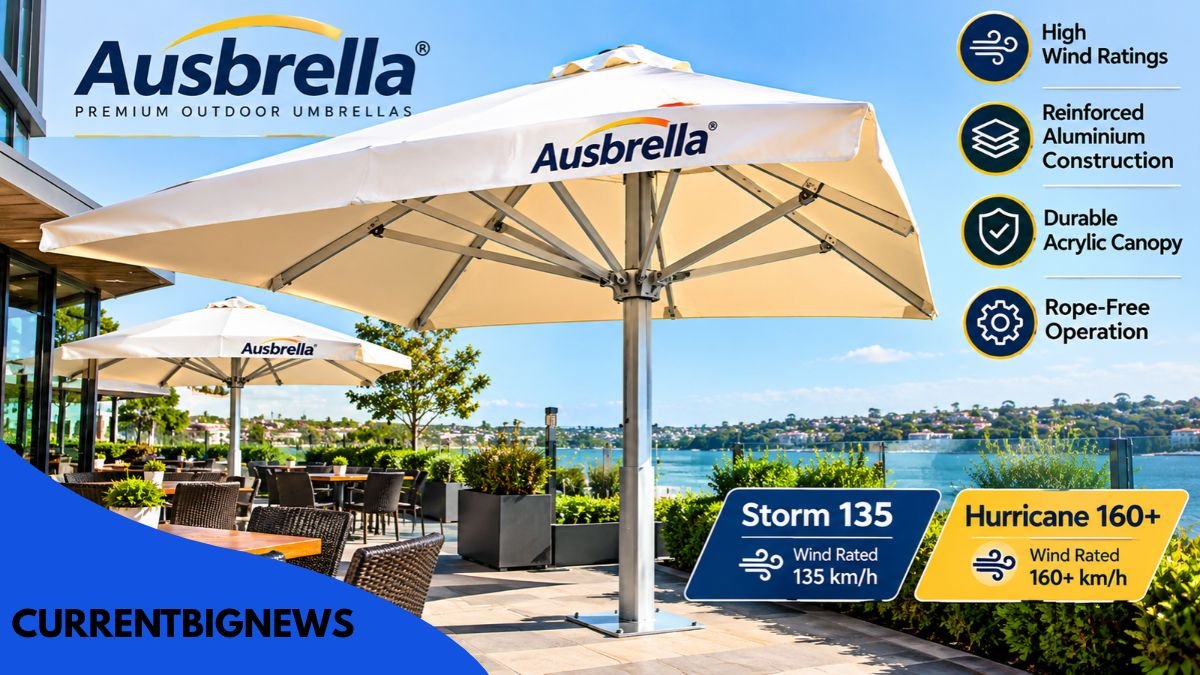
Ausbrella is an Australian-made range of premium outdoor umbrellas designed to provide reliable shade and greater structural strength in demanding environments. Developed by Melbourne-based manufacturer Awnet, these heavy-duty umbrellas are intended for commercial spaces, resorts, restaurants, public areas and residential outdoor settings where ordinary patio umbrellas may not offer sufficient durability.
Unlike conventional lightweight umbrellas, the range incorporates reinforced aluminum structures, engineered components and secure canopy attachments. Its most notable feature is the manufacturer’s reported wind resistance, with selected models tested in a university wind tunnel.
This article explains what Ausbrella is, who manufactures it, how its engineering works, the differences between available models, and what buyers should consider before installation. It also examines product warranties, wind-resistance claims, and practical ownership considerations.
What Is Ausbrella?
Ausbrella is a range of heavy-duty folding market umbrellas manufactured by Awnet in Australia. These products are designed primarily for larger outdoor spaces requiring dependable shade and an engineered supporting structure.
A typical lightweight patio umbrella relies on relatively simple poles, supporting arms, and opening mechanisms. Such designs may be perfectly suitable for sheltered gardens, but larger commercial umbrellas face additional challenges involving wind pressure, repeated operation and long-term exposure to weather.
The Australian range addresses these challenges through reinforced center poles, specially designed supporting arms, and secure installation components.
Its manufacturer describes the product as the world’s strongest umbrella. However, this statement should be understood as a manufacturer’s marketing claim, rather than an independently established global ranking of every umbrella available.
The documented strength of the range comes from its engineering specifications and manufacturer-reported wind-tunnel testing.
Who Makes Ausbrella?
Ausbrella is designed and manufactured by Awnet, an Australian business specializing in commercial market umbrellas, café barriers and outdoor shade products.
Awnet was established in 1980 and operates from the Melbourne area of Victoria. The company identifies itself as a family-owned Australian manufacturer with an integrated production operation involving product design, metal fabrication, textiles, printing and assembly.
According to Awnet’s published history, founder Chris Pierias developed the concept after recognizing the need for stronger and safer folding outdoor umbrellas.
Rather than simply increasing the size or weight of conventional equipment, the development focused on improving the central structural system, canopy security and opening mechanism.
Awnet operates as a division of Asigns Pty Ltd. Its Australian manufacturing operation also supports customization and after-sales services, although product availability and individual configurations should always be confirmed with the supplier.
How Does Ausbrella Work?
The central engineering concept involves strengthening the parts of an umbrella that experience substantial force when exposed to wind. Several construction features distinguish this range from more conventional alternatives.
Reinforced Twin-Skin Aluminum Pole
One of the most important design features is the twin-skin aluminum center pole.
The center pole carries structural loads between the open canopy and its supporting foundation. A reinforced design can improve resistance to bending while balancing the need for strength and manageable material weight.
Awnet uses this approach in its Storm model and a further reinforced double twin-skin arrangement in the Hurricane version.
The exact performance of either design depends on its dimensions, engineering, and installation rather than the pole material alone.
Secure Canopy and Supporting Arms
The umbrellas use eight radial arms and an interlocking frame arrangement designed to support the fabric canopy.
Awnet also specifies a bolted-on fabric cover, rather than relying exclusively on simpler attachment methods.
Secure canopy attachment is particularly important because a large umbrella presents a substantial surface to moving air. Wind can create uplift, bending forces and uneven loads across the structure.
A well-designed frame must transfer these forces through its joints, center pole, and mounting system.
Opening Without Conventional Ropes
Another characteristic is the rope-free opening mechanism.
Traditional commercial umbrellas frequently use pulley and rope arrangements to raise or lower their canopies. Awnet’s premium range instead uses an opening design that eliminates conventional exposed ropes and pulleys.
The manufacturer also describes gas-strut assistance within the range.
This design may make routine operation more convenient, although users must still follow the instructions supplied with their particular model.
Ausbrella Models: Storm 135 and Hurricane 160+
Awnet’s published product range features two principal models, each intended for different levels of wind exposure.
Storm 135: Strong General-Purpose Commercial Shade
The Storm 135 is designed for locations requiring greater wind resistance than many ordinary outdoor umbrellas provide.
Its dedicated manufacturer specification lists a wind rating of 135 kilometers per hour, supported by Awnet’s reported testing at the Monash University wind-tunnel facility.
The Storm model incorporates the twin-skin center pole, eight radial supporting arms, a bolted fabric cover and an engineered frame.
It also includes a matching stainless-steel in-ground socket.
There is a minor inconsistency within the manufacturer’s published information: its general range page mentions 140 km/h for Storm umbrellas, while the dedicated Storm 135 product page specifies 135 km/h. Buyers should use the current model-specific technical documentation when making engineering or purchasing decisions.
Hurricane 160+: Designed for More Demanding Locations
The Hurricane 160+ is the higher wind-rated option.
According to Awnet, this umbrella has undergone wind-tunnel testing at speeds exceeding 160 kilometers per hour, with the manufacturer describing testing at approximately 161 km/h.
Its reinforced double twin-skin pole provides an additional structural distinction from the Storm model.
Awnet presents the Hurricane as suitable for particularly demanding Australian wind regions, including certain coastal locations.
However, selecting this model does not eliminate the need for proper foundations, professional assessment, or responsible operation during severe weather.
Understanding Wind Ratings and Safety
Wind resistance is one of the main reasons potential buyers investigate Ausbrella. Nevertheless, a published wind rating requires careful interpretation.
Wind-tunnel performance is not the same as unrestricted permission to operate an umbrella during severe storms.
Testing can demonstrate how a particular design responds under controlled conditions. Real outdoor locations introduce additional variables, including surrounding buildings, terrain, turbulent gusts, canopy dimensions, and the effectiveness of the supporting foundation.
An umbrella installed on an exposed rooftop may experience conditions very different from those in a sheltered courtyard.
The manufacturer states that engineering certification and Monash University wind-tunnel reports are available upon request.
Commercial purchasers should request these documents and confirm that the specifications apply to the exact model and configuration being considered.
For particularly exposed locations, a qualified engineer or other suitably competent professional may need to assess the proposed installation.
Installation and Anchoring Requirements
Even a carefully engineered umbrella relies on an appropriate connection to the ground.
Awnet identifies matching stainless-steel in-ground sockets among the principal features of its premium range.
An in-ground socket creates a defined connection between the umbrella and its supporting structure. However, the adequacy of an installation depends on more than the socket itself.
Ground conditions, foundation dimensions, surrounding structures and local requirements can affect the suitability of the mounting arrangement.
Commercial operators should confirm any relevant council permissions and obtain appropriate installation instructions before construction begins.
It is also important to keep pathways, entrances and accessible routes clear when determining umbrella positions.
Where people regularly gather beneath outdoor shade structures, routine inspections and appropriate operating procedures are essential.
Owners should close or secure umbrellas whenever required by the manufacturer’s instructions, local safety procedures, or changing weather conditions.
Where Can Ausbrella Be Used?
Ausbrella is particularly relevant to environments where outdoor shade is required for extended periods, and equipment must withstand regular commercial use.
Hospitality businesses may use engineered market umbrellas to provide sheltered seating for restaurants, cafés and outdoor dining areas.
Hotels and resorts may require similar structures for poolside spaces, courtyards and recreational facilities.
Public-space applications can include council-managed areas and other outdoor gathering places where structural reliability and maintenance access are important.
Premium residential properties may also benefit from stronger shade equipment, especially where the outdoor setting is exposed to frequent wind.
However, this level of engineering is not necessarily required for every garden. A lightweight, properly installed patio umbrella may remain sufficient for a sheltered domestic space.
The appropriate choice depends on site exposure, budget, desired canopy coverage and expected frequency of use.
Canopy Materials, Durability and Maintenance
Awnet specifies acrylic canvas covers for its premium models and promotes solution-dyed acrylic fabrics across its wider umbrella range.
Such materials are selected for properties including color retention and resistance to outdoor deterioration.
However, fabric longevity still depends on environmental exposure, maintenance and the particular material supplied.
Routine cleaning should follow manufacturer instructions rather than aggressive cleaning methods that could damage protective finishes or fabric treatments.
Owners should regularly inspect the frame, joints, canopy attachment points and mounting hardware.
Any unusual movement, damaged components, or deterioration should be assessed before further use.
Awnet also promotes repair and refurbishment services, potentially allowing some components to be maintained or replaced instead of discarding the complete structure.
Warranty and Long-Term Value
Both the Storm 135 and Hurricane 160+ are advertised with a five-year warranty on their frames and acrylic canvas covers.
This is longer than the standard three-year frame-and-cover warranty Awnet publishes for certain other market umbrella products.
However, a warranty period alone does not establish which kinds of damage are covered.
Buyers should request the complete current warranty conditions, including any exclusions relating to misuse, installation, exceptional weather events, or maintenance.
The long-term cost of ownership also deserves attention.
A less expensive umbrella may initially seem attractive, but frequent fabric replacement, repairs or complete replacement could increase its overall cost.
For commercial premises, downtime and disruption to outdoor seating may create additional expense.
A meaningful value comparison therefore considers purchase price, installation, expected maintenance, repair availability and warranty coverage.
How Much Does Ausbrella Cost?
Awnet’s main product pages do not provide a single fixed public retail price for the entire range.
The final quotation may depend on the selected model, dimensions, fabric, colors, optional branding, mounting arrangements, delivery and installation requirements.
A restaurant purchasing several umbrellas may have different requirements from a homeowner ordering one unit.
Rather than relying on an unverified online estimate, prospective buyers should obtain a written quotation covering the exact product configuration.
They should also determine whether delivery, installation, and required structural work are included.
How to Choose the Right Model
Choosing between Storm 135 and Hurricane 160+ should begin with the proposed location rather than the highest advertised wind figure.
The first consideration is the site’s exposure. A sheltered restaurant courtyard and an open coastal terrace may require substantially different levels of structural performance.
Next, buyers should measure the area requiring shade, identify suitable mounting positions and consider how people will move beneath the canopy.
The third consideration is engineering documentation. Buyers should obtain the current specifications and confirm that the proposed installation is suitable.
Finally, compare maintenance requirements, warranty terms and the full installed cost.
The strongest available model is not automatically the most appropriate or economical option. A correctly specified product and suitable mounting system are more valuable than choosing solely by a headline wind rating.
FAQs
1. What is Ausbrella?
It is an Australian-made range of heavy-duty outdoor market umbrellas produced by Awnet. The range is designed for commercial and residential applications where robust construction and wind resistance are important.
2. Is the Hurricane 160+ really wind resistant?
Awnet reports that the Hurricane 160+ has been wind-tunnel tested at speeds exceeding 160 km/h. Actual suitability depends on the installation, location, and operating conditions, so the published figure should not be treated as an unconditional safety guarantee.
3. Where are these umbrellas manufactured?
Awnet states that its premium umbrella range is designed and manufactured in Australia. The company’s manufacturing operation is based in the Melbourne area of Victoria.
4. Do the umbrellas come with a warranty?
Yes. Awnet advertises a five-year warranty covering the frames and acrylic canvas covers of its Storm 135 and Hurricane 160+ models. Customers should check the complete terms and exclusions before purchasing.
5. Are these umbrellas suitable for home gardens?
Yes, they may suit premium residential outdoor areas, particularly where stronger construction is desirable. However, smaller or more sheltered gardens may not require the same level of commercial-grade engineering.
Conclusion
Ausbrella represents a specialized approach to outdoor shade, combining reinforced aluminum construction, engineered frame components and manufacturer-reported wind-tunnel testing.
Its principal products, Storm 135 and Hurricane 160+, address different levels of wind exposure while sharing important features such as secure canopy attachments, rope-free operation and five-year frame-and-cover warranties.
The manufacturer’s published specifications provide a useful starting point, but buyers should distinguish documented testing from broad marketing claims. No umbrella should be considered universally safe under every weather condition.
For restaurants, resorts, public spaces and exposed residential areas, the range offers an option worth investigating. The most sensible purchasing decision will depend on the exact site’s conditions, appropriate engineering assessment, installation requirements and long-term ownership costs.