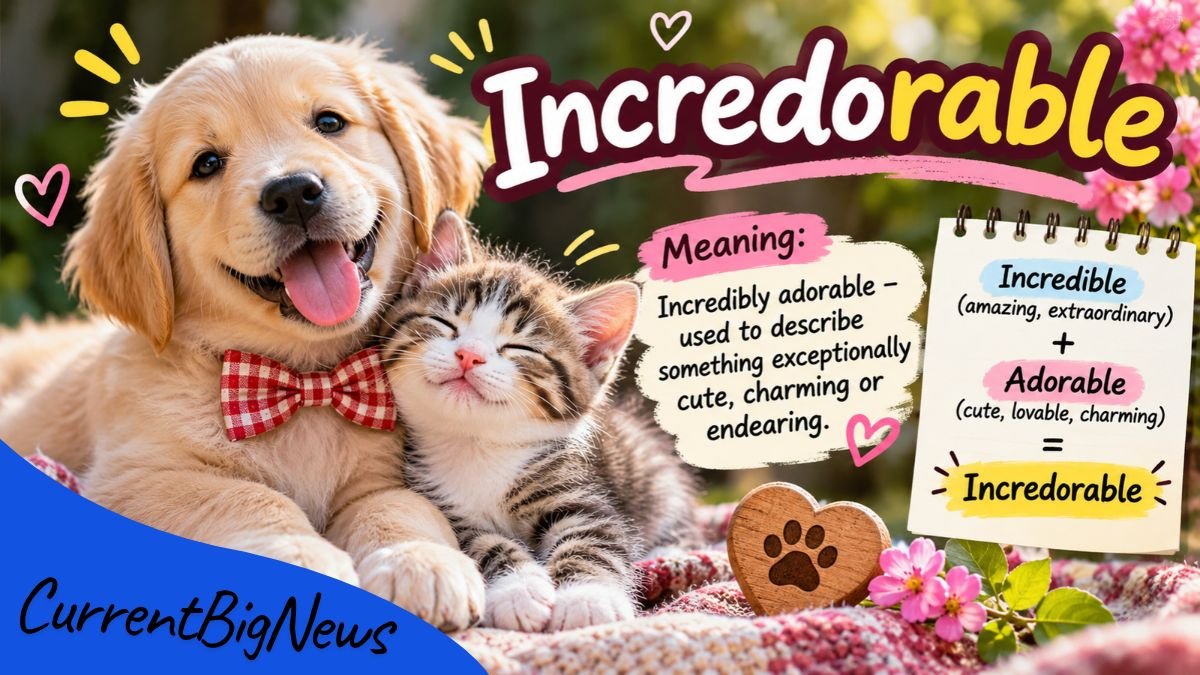
An unfamiliar word does not always need a complicated explanation. Sometimes its meaning becomes clear as soon as its two familiar parts are recognized. Incredorable is a playful combination of “incredible” and “adorable”, used to suggest that something is exceptionally cute, charming, or endearing. It is a compliment with a little extra excitement built into it. The expression has appeared in published English, although that does not make it a standard term for every situation. Readers who encounter it in a caption, message, or unusual name may wonder whether it is genuine language, an accidental misspelling, or a newly invented brand. Understanding how the word is constructed helps answer those questions without making unsupported claims about its history or popularity.
What Does Incredorable Mean?
The simplest definition is “incredibly adorable.” The word combines an expression of astonishment with one of affection. “Incredible” suggests that something is extraordinary or impressive; “adorable” conveys warmth, sweetness, or charm. Put together, they create an enthusiastic description of something that seems almost impossibly cute. A tiny puppy taking its first uncertain steps might invite this reaction, as might an unexpectedly thoughtful handmade gift. The feeling matters more than any technical definition: a speaker is not merely observing that an object looks pleasant but expressing genuine delight.
This is why the blend is better understood as expressive vocabulary than as an objective rating. Two people can see the same photograph and react differently. One may call it sweet, another funny, and another may reach for a deliberately exaggerated word. No measurable level of cuteness makes the adjective correct. Like many affectionate descriptions, it communicates the speaker’s response. The more informal the setting, the easier that intention is to recognize.
The Difference Between Being Amazing and Being Lovable
The source words are not interchangeable. A scientific discovery can be incredible without being adorable; a sleepy kitten can be adorable without being extraordinary. Together, they suggest surprise and tenderness. Used for a child’s amusing drawing, it conveys fond astonishment. Used for an engineering achievement, it sounds odd unless the writer intends humor. The emotional overlap makes the blend distinctive.
Where Did the Expression Come From?
The construction follows a familiar process called word blending, sometimes described as making a portmanteau. English speakers create blends by joining recognizable parts of existing words. Established examples include “brunch”, from breakfast and lunch, and “smog”, from smoke and fog. Not every blend becomes everyday vocabulary. Some remain occasional jokes or expressions shared within a small social circle. Others become common enough that their unusual origins are easily forgotten. The presence of two recognizable parts makes this particular invention relatively easy to interpret, even if a reader has never seen it before.
Its history also has a useful documented point. On May 16, 2017, the American newspaper The Star Tribune published a “word of the week” item by James Lileks under a headline featuring the expression. The short column defined the term as “incredibly adorable” and treated it as an exaggerated, humorous compliment. That is evidence of a published use by 2017. It does not show that Lileks invented the expression, nor does it identify the first person to say or write it. Creative blends can be coined independently by different speakers, so identifying a single origin requires stronger evidence than one newspaper appearance.
Why a Dated Example Matters
A dated publication establishes that a term existed by that date, not that it was invented then. Earlier conversations and unpublished writing may have escaped the record. A precise inventor, birthplace, or claim of worldwide popularity would require further evidence. An interesting expression needs no elaborate origin story.
How to Use the Word Naturally
Incredorable works best as an informal adjective. It can appear before a noun, as in “an incredorable little puppy”, or after a linking verb, as in “That handmade card is incredorable.” Both constructions are understandable because the word occupies the same grammatical position as “adorable”—no need to invent complicated rules. What matters is whether the surrounding sentence gives readers enough clues to recognize the affectionate tone.
Consider three original examples. A kitten sleeping inside an empty slipper provides the kind of cute, unexpected sight that might inspire the adjective. “Her grandfather made a miniature bench for the garden fairies; the detail was incredorable” combines craftsmanship and affection. “The children’s thank-you notes were incredorable” describes a warmly surprising gesture rather than a literal physical appearance. These examples show how the expression can apply to behavior and thoughtful actions, not just to small animals or attractive objects.
When a Playful Compliment Works Best
Private messages, social captions, and character dialogue allow room for exaggeration and invented phrases. Used sparingly, the expression adds personality and reveals a speaker’s reaction. Repeat it too often, and the surprise fades. When writing for English learners or readers who may lack context, a familiar synonym or brief explanation can communicate more clearly.
Is Incredorable a Real English Word?
Whether a word is “real” depends on what you mean by the question. People can create a new expression, understand it, and use it meaningfully before it appears in a major dictionary. The documented newspaper example shows that this spelling has been used intentionally in published writing. Yet documented usage is not the same as standard dictionary status. The expression is best treated as informal wordplay, not as universally recognized formal English. Someone who has never encountered it may reasonably assume it is a typo or ask for an explanation.
Dictionaries generally describe patterns of language use rather than deciding which combinations people may invent. A term becomes familiar through usage, repetition and shared understanding, but not every clever coinage reaches a broad audience. That is why writers should avoid claiming the expression has an officially fixed pronunciation, a recognized linguistic authority, or widespread acceptance without specific evidence. Its meaning is accessible; its level of acceptance is more limited and less certain.
Incredorable Compared With Similar Descriptions
The best choice depends on what matters most. Adorable communicates affection; incredible expresses amazement without necessarily suggesting warmth. Delightful describes a pleasing experience, while endearing suits lovable behavior or character. Heartwarming emphasizes emotional kindness. “Irresistibly cute” offers similar intensity without asking a reader to decode a new expression.
These alternatives cannot be swapped mechanically. Helping a neighbor may be heartwarming rather than cute, while a rare astronomical sight can be incredible without being endearing. For playful writing, a surprising blend can be expressive. For reports, instructions and broad audiences, the more precise familiar word is usually better.
Can It Also Be a Brand, Website or Username?
A distinctive expression can also be adopted as a name. That possibility does not mean every appearance of the spelling refers to the same business, person, or online account. A search result might be a dictionary-style explanation, an informal comment, a username, or a reference to a website. The surrounding information must establish which meaning is intended. Inferring a company’s founder, product range, ownership, or operating history from the spelling alone would be misleading.
Anyone considering the name for a project should also separate linguistic appeal from commercial availability. A memorable label can suit an affectionate or playful concept, but a domain being visible in search results is not proof that a corresponding business is active or trustworthy. Before making purchases from an unfamiliar site, readers should look for current contact information, transparent terms, secure payment arrangements, and credible independent feedback. Before adopting a name commercially, checking relevant trademark and domain records is more sensible than assuming an unusual word is unused.
Tips for Writers and Editors
An editor can ask one practical question: does this expression communicate something that a familiar adjective would miss? It may reveal a playful character’s personality or provide the subject of an article about word formation. But in serious reporting, professional advice, or instructions, a familiar word is usually easier to understand. Check whether the sentence makes sense without a picture or emoji; if it does not, add context or choose a clearer alternative.
Most importantly, multiple online discussions do not automatically make an invented term a recognized industry label. Use it because it suits the reader and the subject, not because unusual wording might attract search traffic.
FAQs
What does incredorable mean in simple English?
It means “incredibly adorable”, or unusually cute and charming. It is an enthusiastic, informal compliment rather than a technical term.
Who invented the expression?
No original creator can be established from the reliable evidence discussed here. A Star Tribune column used the expression in May 2017, but no documented example proves where it began.
Is the unusual spelling a mistake?
Not necessarily. It may be an intentional blend of “incredible” and “adorable.” In a formal document, however, readers unfamiliar with the expression might mistake it for an error.
Is the word appropriate for school or professional writing?
It can work when discussing creative word formation or quoting informal speech. In most formal assignments and professional documents, a standard adjective such as “charming,” “remarkable,” or “delightful” will communicate more clearly.
Does the term refer to a specific company or product?
The spelling alone does not identify a particular business or product. Check the surrounding context and independent evidence before treating an online name as proof of an established organization.
Conclusion
The expression shows how English speakers can make a familiar feeling sound fresh by blending existing words. Its meaning is straightforward: something seems so adorable that an ordinary compliment feels insufficient. The expression was documented in a newspaper column in May 2017, but that date should not be confused with a proven invention date. It remains most useful as informal, affectionate wordplay rather than as a formal descriptive label. In a friendly caption, personal message, or humorous piece of dialogue, it can communicate delighted surprise. In writing where clarity matters more than personality, simpler alternatives often work better. The distinction is not between correct and incorrect creativity; it is between language that helps a reader and language that makes the reader work harder.