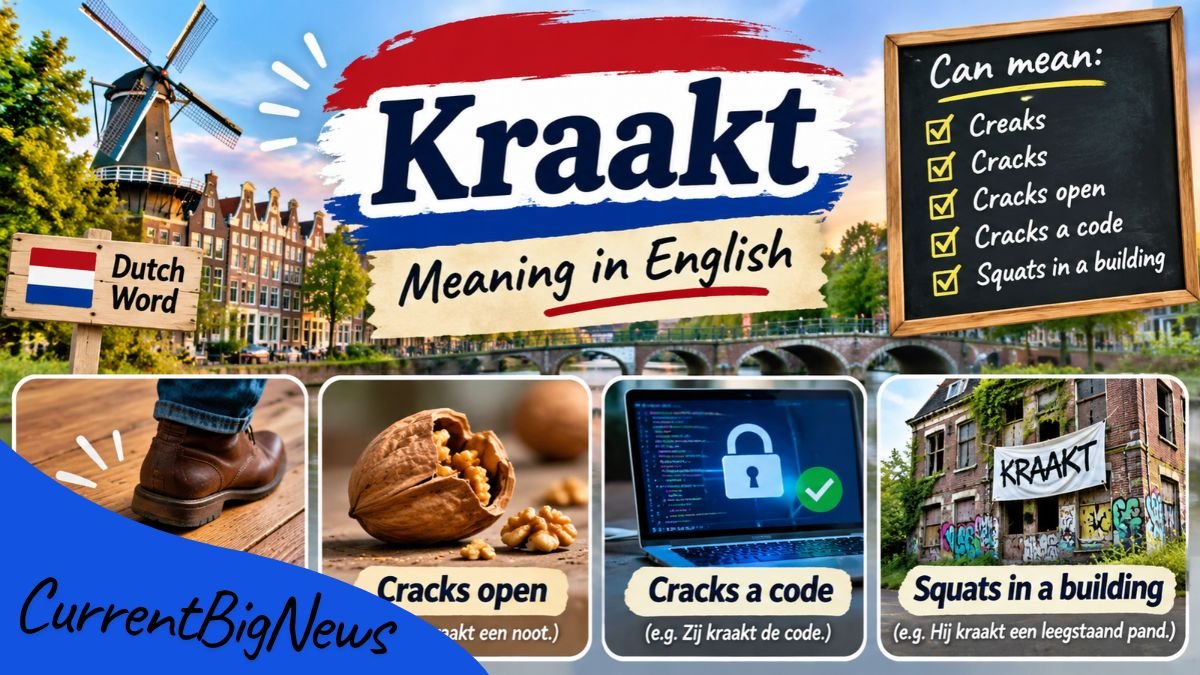
The Dutch word kraakt can mean “creaks,” “cracks,” “cracks open,” or, in particular contexts, “cracks a code” or “squats in a building.” Its meaning depends on the subject, the object, and the surrounding sentence.
For English-speaking readers, this is an interesting example of how one everyday verb can describe several apparently unrelated actions. A wooden floor making noise, somebody opening a difficult lock and a person occupying an empty property may all be described using forms of the same Dutch verb.
Understanding kraakt therefore requires more than memorizing a single English translation. The most reliable approach is to examine its grammatical form, recognize the situation being described, and choose the English equivalent that sounds natural.
This guide explains its meanings, pronunciation, conjugation, everyday expressions, and common translation mistakes.
What Does Kraakt Mean?
Kraakt is the present-tense form of the Dutch verb kraken. It is used with third-person singular subjects such as hij (he), zij (she), and het (it), as well as the informal second-person singular jij or je in normal subject-first word order.
Its most familiar meaning describes a sharp, irregular cracking or creaking sound.
For example:
De houten vloer kraakt.
English translation: “The wooden floor creaks.”
However, the verb also has other established meanings. Depending on the sentence, it may describe opening something by force, solving a code, gaining unauthorized access, or occupying a building without permission.
The key distinction is that the Dutch word has several established meanings, not one universal English equivalent.
This makes context essential, particularly when translating news reports, technical descriptions or conversational Dutch.
The Different Meanings of Kraakt in Everyday Dutch
1. Creaking and Cracking Sounds
The most straightforward meaning concerns sounds produced by friction, pressure, or movement.
Old wooden stairs may creak under someone’s weight. A door may make an unpleasant noise when you open it. Ice can crack as its surface moves or is stressed.
Consider the sentence:
De deur kraakt als je hem opent.
Translation: “The door creaks when you open it.”
Here, the verb describes an audible effect rather than an object actually breaking apart.
English distinguishes between creaking, cracking, squeaking, and snapping. Dutch can use kraken across several related sound descriptions, although other Dutch verbs may be more precise in particular situations.
The English translation should therefore reflect the sound being described.
A floorboard is more likely to “creak,” while a brittle object might “crack.” Translating both situations with the same English word could make a sentence less accurate.
2. Breaking Open Objects
Another established meaning involves breaking something open, particularly when pressure or force is involved.
A familiar example is cracking nuts.
Hij kraakt een noot.
Translation: “He cracks a nut.”
The action is physical, and the context makes the meaning clear.
The same underlying verb can appear in descriptions of breaking open a safe or overcoming a physical barrier. However, an English translator should distinguish between simply opening something and forcing it open.
For instance, “cracks a safe” conveys a different activity from “opens a safe.”
This distinction matters because the Dutch expression can imply difficulty, resistance, or an attempt to overcome protection.
3. Breaking Codes and Digital Security
In computing and technology, kraken can refer to cracking a password, code, or security mechanism.
The expression describes overcoming a technical or informational obstacle.
For example:
De onderzoeker kraakt de code.
Translation: “The researcher cracks the code.”
The precise meaning depends on what kind of code is involved. It might refer to solving a puzzle, deciphering protected information, or defeating a security measure.
These activities should not automatically be treated as identical.
Authorized cybersecurity testing, criminal unauthorized access, and ordinary puzzle-solving serve different purposes and involve different legal circumstances, even when their descriptions use similar vocabulary.
In technology reporting, a responsible translation should identify what actually happened rather than assuming a particular motive.
The word alone does not establish whether an activity was lawful, malicious, or part of approved security research.
4. Occupying Empty Buildings
One culturally significant meaning of the Dutch verb kraken is associated with squatting.
In this context, the word refers to occupying a building without the owner’s permission, often an empty residential or commercial property.
An example is:
Hij kraakt een leegstaand pand.
Translation: “He squats in an empty building.”
This usage connects to Dutch social and political history.
Squatting became a prominent issue in the Netherlands during debates about housing shortages, vacant buildings, property ownership and urban development.
Squatter movements also featured in wider discussions about housing access and the use of abandoned properties.
However, the historical background should not be confused with the current legal position.
Squatting has been a criminal offense in the Netherlands since October 1, 2010. The Dutch government’s guidance confirms that occupying a property without permission can have criminal consequences.
The language itself remains relevant in news reporting, political debate and historical writing.
When translating a housing-related sentence, “squats” or “occupies without permission” will usually be more informative than the literal English word “cracks.”
Kraakt in Dutch Grammar
Recognizing kraakt’s grammatical role makes translation considerably easier.
The original infinitive is kraken, equivalent to English “to crack” or “to creak,” depending on context.
It is a regular Dutch verb that follows the standard weak-verb conjugation pattern.
Present, Past and Perfect Forms
Dutch formGrammatical use
Kraken Infinitive
Ik kraak I crack or creak
Jij kraakt You crack or creak
Hij/zij/het kraakt He/she/it cracks or creaks
Wij kraken We crack or creak
Kraakte Singular simple past
Kraakten Plural simple past
Gekraakt Past participle
These forms help readers identify when an action occurs and who performs it.
For example, De vloer kraakte means “The floor creaked,” placing the sound in the past.
Similarly, De vloer heeft gekraakt uses the perfect tense and can be translated as “The floor has creaked.”
Dutch tense choices don’t always match English preferences, so context remains important.
Why Does the Final T Sometimes Disappear?
An important grammatical detail occurs in questions involving jij or je.
Compare:
Jij kraakt de code.
“You crack the code.”
Kraak jij de code?
“Do you crack the code?”
When the subject jij follows the finite verb in this construction, the final -t disappears.
This is a standard feature of Dutch verb conjugation, not a spelling mistake.
By contrast, third-person singular forms retain the ending in ordinary questions.
This distinction is particularly useful for language learners who encounter different forms of the same verb in written conversations.
How to Pronounce Kraakt Correctly
The Dutch pronunciation can be represented approximately as /kraːkt/ in the International Phonetic Alphabet.
For an English speaker, it sounds roughly like “krahkt,” with a long vowel and a pronounced consonant ending.
The double aa in Dutch spelling represents a long vowel sound. It should not be treated as two separately spoken vowels.
The final -kt combination is also important. Both consonants belong to the same syllable.
Unlike the infinitive kraken, which has two syllables, this conjugated form has only one.
English-speaking learners sometimes add a vowel after the final consonant cluster, making the word longer than intended.
A useful practice method is to pronounce the long vowel clearly and then finish with the k and t sounds together.
Listening to standard Dutch speech helps you develop a more accurate accent.
Common Dutch Sentences and Their English Translations
The following examples illustrate how the same verb can change meaning across different situations.
Dutch sentence Natural English translation
De vloer kraakt. The floor creaks.
Mijn stoel kraakt. My chair creaks.
Het ijs kraakt. The ice cracks.
Hij kraakt een noot. He cracks a nut.
Zij kraakt de code. She cracks the code.
De oude trap kraakt. The old staircase creaks.
Hij kraakt een kluis. He cracks a safe.
De deur kraakt. The door creaks.
De groep kraakt een pand. The group squats in a building.
Het vriest dat het kraakt. It is freezing extremely hard.
The last example deserves particular attention.
Het vriest dat het kraakt is an established Dutch expression describing extremely cold weather.
A literal translation such as “It freezes so much that it cracks” may preserve part of the imagery, but it sounds unnatural in ordinary English.
A clearer translation communicates the intended intensity of the cold.
This demonstrates why interpreting a complete expression is often more useful than translating individual words separately.
The Difference Between Kraken, Kraak and Gekraakt
Several closely related Dutch forms can confuse learners.
Kraken is the infinitive verb. It describes the general action, such as creaking or cracking.
Kraak can function as the first-person singular present-tense form. It is also a noun associated with a cracking sound and, in particular contexts, a break-in or squatting.
Gekraakt is the past participle, which appears in completed-action constructions.
Meanwhile, krakend is a present participle that can also function adjectivally.
For example, een krakende vloer means “a creaking floor.”
A related verb, afkraken, commonly means to criticize something very harshly. Its present-tense form can appear as afkraakt or with the separable prefix placed later in the sentence.
These distinctions matter because small changes in spelling or grammatical structure can produce substantially different meanings.
Why Context Matters More Than Literal Translation
A reliable translation begins by asking what the sentence describes.
If the subject is a wooden staircase, the meaning is probably an audible creaking sound.
If the object is a code, the writer is more likely describing the successful solution or defeat of some form of protection.
If the surrounding discussion concerns vacant property and housing rights, the intended meaning may be squatting.
The same principle applies when translating headlines. Dutch journalism frequently relies on compact expressions whose meanings are obvious to native readers but less clear to international audiences.
An automatic translation might choose an acceptable dictionary equivalent without capturing the full situation.
For professional writing, the better approach is to examine the subject, the object, the surrounding paragraph, and the tone.
Good translation preserves the intended meaning, not simply the original word order.
Common Mistakes English Speakers Should Avoid
One frequent error is assuming that the Dutch word always means “cracks.”
Although that translation is correct in some contexts, it may sound unnatural when discussing doors, furniture, or wooden floors.
Another mistake is treating kraken as synonymous with computer hacking in every situation. Cybersecurity is only one of several domains where the verb appears.
Confusion can also arise between the base verb and related compounds such as afkraken, which has its own established meaning.
Pronunciation presents a further challenge because ordinary English spelling does not reproduce the long Dutch vowel and final consonant cluster perfectly.
Finally, readers should avoid concluding legality or intention from a single verb. In reports about technology or property occupation, the surrounding facts determine the appropriate interpretation.
These simple distinctions make Dutch articles, subtitles and everyday conversations much easier to understand.
FAQs
1. What does kraakt mean in English?
It most commonly means “creaks” or “cracks.” Depending on the sentence, it can also describe cracking a code, breaking something open, or squatting in a building.
2. Is it a Dutch word?
Yes. It is a conjugated present-tense form of the regular Dutch verb kraken. The form is used with several singular subjects.
3. How is it pronounced?
The approximate pronunciation is /kraːkt/. It is a single-syllable word with a long vowel and a final -kt consonant cluster.
4. Can the word refer to hacking?
Yes, in certain technical contexts. However, it can also describe legitimate code-breaking or puzzle-solving, so the surrounding information must establish the actual activity.
5. What is the difference between kraken and gekraakt?
Kraken is the infinitive, while gekraakt is the past participle. The latter appears in constructions describing completed actions, such as heeft gekraakt.
Conclusion
Kraakt demonstrates how a familiar Dutch verb can carry several distinct meanings while remaining grammatically straightforward. Its central uses include creaking sounds, physically cracking objects, breaking codes, and occupying buildings without permission.
The correct English translation depends primarily on context. A floor creaks, a nut cracks, a password may be cracked, and a vacant property may be squatted in. Each situation calls for different English wording, even though Dutch uses closely related forms.
Understanding the infinitive kraken, its conjugation, and its associated expressions provides a practical foundation for interpreting the word accurately.
For readers, translators, and Dutch-language learners, the key takeaway is simple: identify the action being described before choosing the English equivalent.