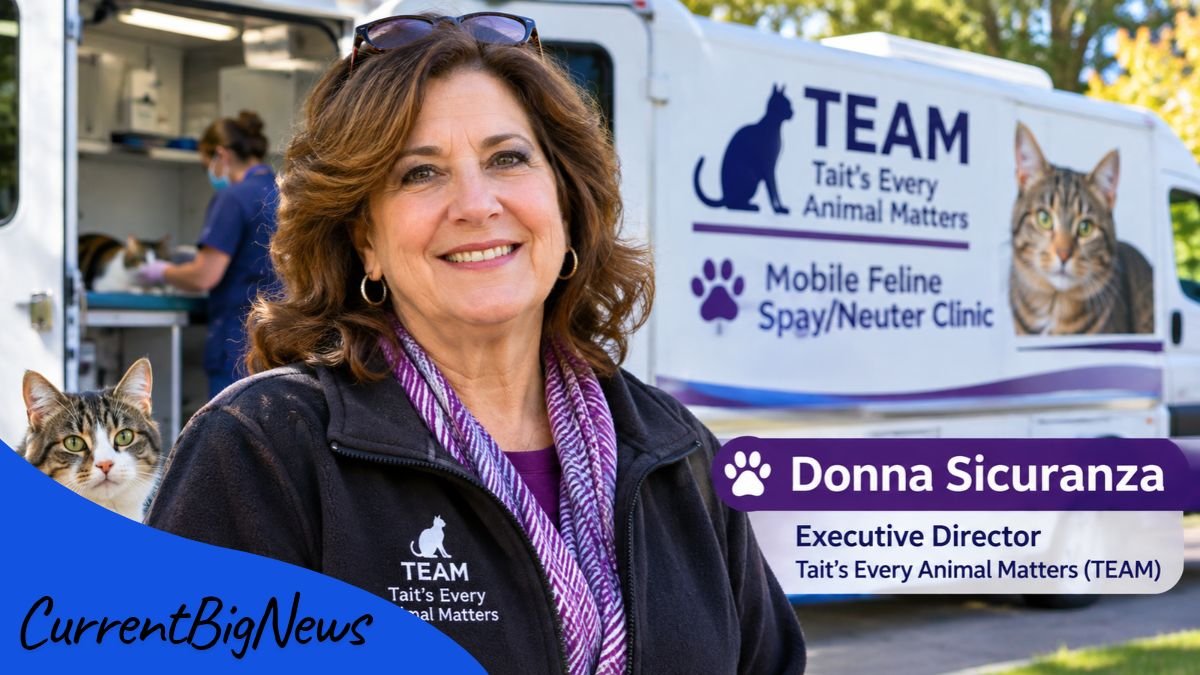
Donna Sicuranza is a longtime nonprofit executive and animal welfare advocate associated with Tait’s Every Animal Matters (TEAM), a Connecticut organization providing affordable veterinary services for cats. Professionally identified today as Donna Sicuranza Marconi, she helped develop a mobile feline spay, neuter, and vaccination program that began operating in 1997. The organization reports that its veterinary professionals have sterilized and vaccinated more than 225,000 cats since its launch.
Her story is about more than operating a veterinary service. It involves decades of organizational leadership, public communication, community cooperation, and efforts to address feline overpopulation. Although detailed information about her personal life is limited, official organizational records and Connecticut government documents establish important aspects of her career.
This article examines her professional background, contributions to TEAM, partnership with veterinarian John A. Caltabiano, and the difference between verified facts and unsupported biographical claims.
Who Is Donna Sicuranza?
Donna Sicuranza is an American nonprofit professional best known for her leadership at Tait’s Every Animal Matters, commonly abbreviated as TEAM. The organization operates a mobile veterinary clinic serving domestic and feral cats in communities throughout Connecticut.
TEAM’s official staff directory identifies her as Donna Sicuranza Marconi, Executive Director. Historical organizational publications and government records generally use the shorter name.
Her public recognition comes primarily from animal welfare rather than entertainment, politics, or social media. She has been associated with TEAM since developing its mobile clinic in the 1990s.
Unlike a veterinary doctor, an executive director works on the organizational side of a nonprofit. This distinction matters because her contributions focus on leadership and the long-term development of a charitable service, while qualified veterinary professionals provide medical treatment.
TEAM’s continued operation shows how administrative leadership and specialist veterinary knowledge can work together to address a practical community problem.
Donna Sicuranza’s Early Life and Professional Background
Reliable public information about Donna Sicuranza’s childhood, exact birthplace, and date of birth remains limited. Although some online biographies discuss her family and education, not every personal detail can be independently established through authoritative records.
Her documented professional history offers a clearer starting point.
A Connecticut Magazine report published in 2013 described her as having worked in journalism and public relations before becoming deeply involved in the mobile veterinary program.
These earlier professional experiences are relevant because nonprofit organizations depend heavily on communication. Explaining a service to potential users, maintaining relationships with community organizations, and communicating with supporters are important parts of operating a charitable program.
Writing and public relations also require the ability to translate complicated subjects into information that ordinary readers can understand.
For an organization concerned with feline population control, public understanding matters. People need accurate explanations of why sterilization is recommended, what veterinary services are available, and how preventive care can support animal welfare.
While her complete employment and educational history is not well documented in the strongest public sources, her communications work provides useful context for her later career.
How TEAM’s Mobile Veterinary Clinic Began
The history of TEAM’s mobile clinic is central to understanding Donna Sicuranza and her professional achievements.
During the 1990s, concerns about unwanted kittens, abandoned cats, and limited access to affordable veterinary treatment encouraged animal welfare organizations to seek practical solutions.
Traditional veterinary practices provided essential care, but their services were not always affordable or conveniently located for every cat owner or caretaker.
This was particularly important for individuals caring for several cats, including animals living outdoors or in managed colonies.
TEAM took a different approach: instead of relying entirely on people traveling to a permanent veterinary facility, the organization brought a specialized clinic directly into communities.
Planning for the TEAM Mobile Feline Spay/Neuter Clinic began in 1996 under the direction of veterinarian Dr. John A. Caltabiano and Executive Director Donna Sicuranza.
The clinic officially began operating on March 1, 1997.
According to TEAM’s published history, the clinic sterilized and vaccinated ten cats on its first day of operation. The program expanded rapidly as more Connecticut residents learned about its services.
The Importance of the Mobile Clinic Model
The mobile approach addressed an important practical issue: access.
People caring for stray or feral cats often face challenges involving transportation, veterinary costs, and the logistics of arranging treatment for multiple animals.
A traveling clinic can reduce some of these obstacles by providing services at scheduled locations.
The program also lets it concentrate specialist equipment and veterinary staff in one mobile facility.
However, this model still requires substantial coordination, financial resources, experienced professionals, and careful attention to animal health and safety.
Its success depends on much more than owning a vehicle. Appointments, equipment, staffing, maintenance, scheduling, and community relationships must all function effectively.
TEAM’s long history illustrates the importance of maintaining those systems consistently.
The Role of Donna Sicuranza in Animal Welfare
Donna Sicuranza has been involved in TEAM’s development and leadership for nearly three decades.
Her position has involved representing an organization focused on improving access to feline preventive care and reducing unwanted cat populations.
Official records provide examples of her participation beyond routine nonprofit administration.
In March 2007, she appeared before Connecticut’s legislative Environment Committee and spoke in support of proposed animal population control measures.
During that hearing, she identified herself as TEAM’s Executive Director and explained the organization’s experience providing affordable sterilization services.
She also described her participation in an advisory committee examining animal population control policies.
At the time, TEAM was approaching its tenth anniversary and the completion of its 100,000th spay or neuter procedure.
That testimony matters because it shows her direct involvement in public policy discussions on animal welfare.
How Donna Sicuranza Helped Communicate TEAM’s Mission
Public education has been an important part of TEAM’s history.
The organization’s communications explain the relationship between affordable veterinary care, responsible ownership, and efforts to reduce unwanted litters.
Sicuranza’s earlier experience in journalism and public relations appears especially relevant to this work.
TEAM’s 2019 newsletter also identifies her as its editor, establishing that her communications responsibilities continued alongside her executive leadership.
An animal welfare nonprofit must communicate with different groups, including cat owners, rescue volunteers, veterinary professionals, donors, and local communities.
Each group may have different priorities and questions.
Clear explanations help people understand available services and the purpose behind the organization’s activities.
Her documented work therefore combines nonprofit administration with public communication and advocacy.
Her Professional Partnership With Dr. John A. Caltabiano
A major figure in TEAM’s development was Dr. John A. Caltabiano, the Connecticut veterinarian who helped establish its mobile feline clinic.
Caltabiano brought veterinary expertise and a commitment to improving animal care, while Sicuranza helped develop and administer the program.
Their combined work helped establish a service that continued beyond its experimental beginnings.
Caltabiano was also involved in Connecticut’s broader animal population control discussions.
He died on November 6, 2009, at the age of 55.
A Connecticut Department of Agriculture publication identified Sicuranza as his longtime partner. It stated that she would continue his work with TEAM and FeralStat, a feline population-control initiative associated with him.
That official account establishes an important personal and professional connection between them.
It does not, however, fully explain her later private relationships or current marital status.
Following his death, TEAM continued operating its mobile clinic, with Sicuranza remaining publicly associated with its leadership.
TEAM’s Impact on Connecticut Cat Welfare
One of the clearest measures of TEAM’s work is how many animals its veterinary professionals have treated.
The organization reports that more than 225,000 cats have been sterilized and vaccinated since 1997.
This cumulative figure covers the program’s history, not the number of cats treated in a single year.
TEAM serves both owned cats and feral cats, allowing different groups of caretakers to access its services.
Its primary focus includes spaying, neutering, vaccinations, and selected preventive treatments.
Sterilization helps prevent unplanned litters, while vaccination is an important part of protecting feline health.
These services also contribute to broader efforts to manage cat populations responsibly.
Why Affordable Preventive Care Matters
Veterinary expenses can be challenging for households with limited budgets. People caring for unowned animals may face additional financial strain because they support cats that do not belong to a conventional household.
Affordable preventive services can help address these problems.
However, sterilization alone cannot resolve every challenge associated with animal welfare.
Responsible ownership, suitable shelter, veterinary follow-up, public education, and cooperation among community organizations remain important.
TEAM’s model concentrates on a defined set of veterinary services rather than attempting to provide every form of animal care.
This focused approach is one reason its long-running program provides a useful example of specialized nonprofit service delivery.
Donna Sicuranza Marconi and the Name Difference
Readers sometimes encounter the names Donna Sicuranza and Donna Sicuranza Marconi and wonder whether they identify different people.
TEAM’s present staff directory uses the professional name Donna Sicuranza Marconi, while its historical publications and Connecticut government records use Donna Sicuranza.
The shared connection to TEAM and its executive leadership provides clear context for understanding these references.
However, the available reliable information does not establish precisely when or why the additional surname began appearing.
It would therefore be inappropriate to invent a wedding date, identify a current husband without confirmation, or construct a detailed personal relationship history based solely on a surname.
Professional records provide the most dependable information about her continuing association with the organization.
Important Clarification About Another Person With the Same Name
Another source of confusion involves Donna Marie Sicuranza, whose obituary was published by Pelham Funeral Home in New York.
That woman was born on March 24, 1942, worked in banking, and died on March 10, 2017.
Her published obituary describes a life associated with the New York area and a long career at the Bank of New York.
These details should not be assigned to the Connecticut nonprofit executive.
The two biographies concern different individuals, despite the similar names.
This distinction matters when researching someone’s age, family relationships, professional background, or death.
An obituary found through a name search is not automatically evidence about every person sharing that name.
Personal Life, Age, and Net Worth
Although her professional achievements are publicly documented, relatively little verified information is available about Sicuranza’s private circumstances.
Her precise birth date and age have not been established through the strongest available organizational or government sources.
Similarly, reliable documentation is insufficient to provide a definitive account of her current marital status, children, or personal finances.
No dependable publicly verified figure establishes her individual net worth.
A nonprofit executive’s professional position should not be confused with personal ownership of an organization’s assets or fundraising income.
Financial resources belonging to a charity are intended for its organizational purposes, not automatically the private property of its leadership.
For these reasons, biographies should prioritize verifiable professional information rather than unsupported personal estimates.
FAQs
Who is Donna Sicuranza?
She is a Connecticut nonprofit executive and animal welfare advocate best known for her longtime leadership at Tait’s Every Animal Matters. The organization operates a mobile veterinary clinic providing feline sterilization and vaccination services.
What is Donna Sicuranza Marconi known for?
She is known for helping develop and lead TEAM’s mobile feline veterinary program. The clinic began operating in March 1997 and has treated more than 225,000 cats, according to the organization’s published figures.
Is Donna Sicuranza a veterinarian?
TEAM identifies her as its Executive Director, not a veterinarian. Its medical services are provided by the organization’s veterinary professionals.
How old is Donna Sicuranza?
Her exact age and date of birth are not reliably established in the primary public records reviewed. The 1942 birth date appearing in a New York obituary belongs to a different woman named Donna Marie Sicuranza.
What happened to John A. Caltabiano?
Dr. John A. Caltabiano died on November 6, 2009. Connecticut government records identify him as Sicuranza’s longtime partner and a key figure in developing TEAM’s mobile veterinary program.
Conclusion
Donna Sicuranza’s documented career shows how sustained nonprofit leadership can build a practical, lasting animal welfare service. As Executive Director of Tait’s Every Animal Matters, she helped develop a mobile veterinary program that began with a small number of cats in 1997 and expanded into a service reporting more than 225,000 sterilization and vaccination procedures.
Her background in communications, involvement in Connecticut animal population control discussions, and longstanding association with TEAM provide the strongest evidence of her professional contribution.
While personal details such as her exact age, current marital status, and net worth remain insufficiently verified, her role in the organization’s history is well established. Her story is best understood through TEAM’s measurable work and its continuing commitment to accessible feline care.